30+ Years
of Medical Experience

If you have been wondering how gut bacteria affect mental clarity, researchers have taken that question seriously for a decade. The short answer: your gut and brain are wired together in a two way conversation, and gut microbes influence how clearly you think through four routes, the vagus nerve, short-chain fatty acids, the tryptophan pathway, and stress hormones.
That conversation is the microbiota-gut-brain axis, and it is the practical answer to how does the gut affect the brain. Below we walk each route in plain language, grade each one honestly, and give you a straight read on psychobiotics: what trials show, and where the marketing runs ahead of data.
Mental clarity is a felt experience, not a diagnosis. It looks like steady attention through a work block, quick recall when a name is almost there, and thinking that does not feel like wading through fog after lunch or after a stressful week.
Underneath that feeling sits a real biological system: the microbiota-gut-brain axis, a bidirectional highway between the gastrointestinal tract and the brain that runs on neural, hormonal, and immune signals at once, as this review in Molecular Psychiatry and Harvard Health’s explainer both describe.
Your gut carries its own network of neurons, which is why people call it the second brain. What you want to know is narrower: does any of this change my daily focus, and is a probiotic worth buying?
Here is the encouraging part: when microbial balance shifts, through diet, stress, a course of antibiotics, or illness, some people notice the signs your gut microbiome is out of balance before anything digestive shows up. Foggy afternoons and slow processing often arrive first, which is where the worry about the microbiome and brain fog comes from. The gut brain axis mental clarity question is legitimate, so let us see how it works.
There are four concrete routes, and each carries a different strength of evidence. Knowing which is which is the difference between an informed decision and an expensive guess.
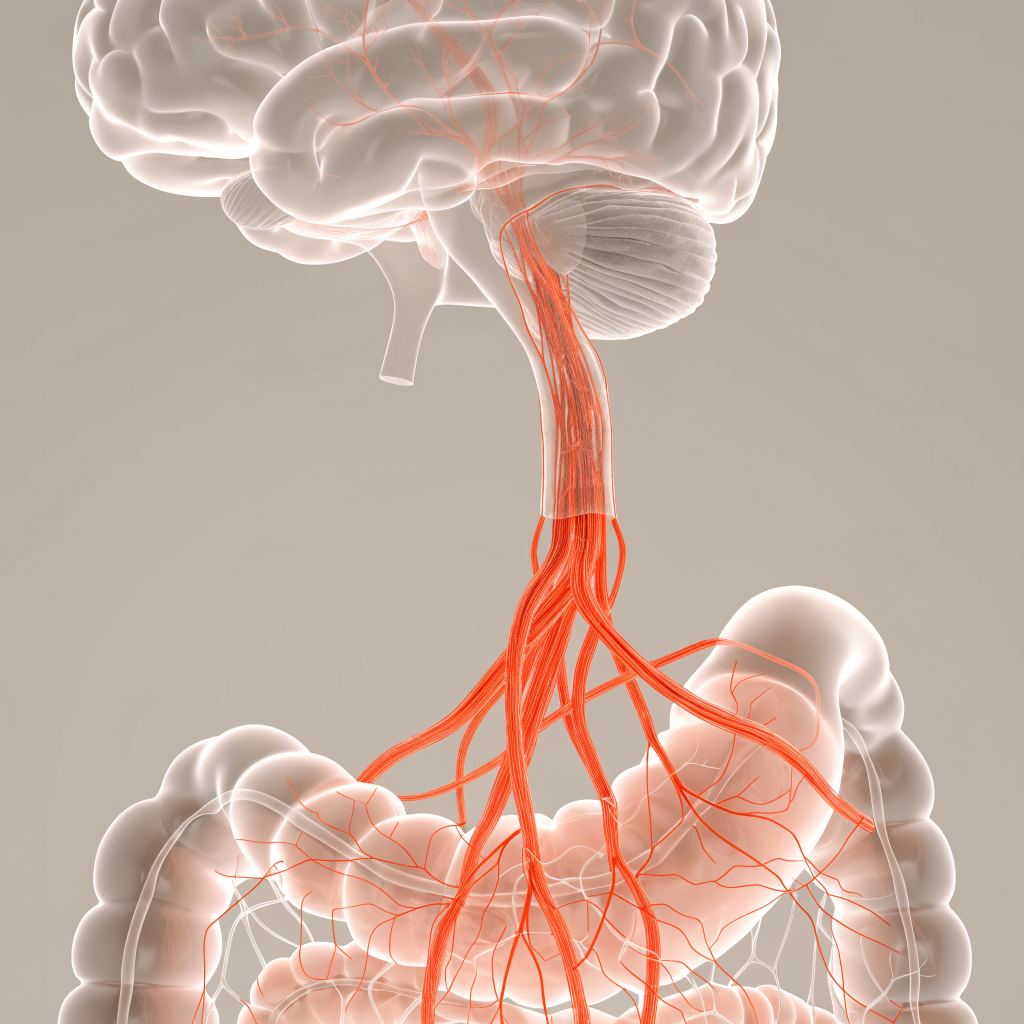
The vagus nerve is the longest cranial nerve in your body, running from the brainstem to the abdomen. About 80 to 90 percent of its fibers carry the gut’s state up to the brain, while the smaller stream sends instructions back down, according to Breit and colleagues in Frontiers in Psychiatry.
Gut microbes and the cells of the gut lining can activate those vagal fibers. Those signals reach nuclei in the brainstem and influence circuits involved in attention and emotion, which makes the vagus nerve gut brain connection one of the best documented parts of this story.
Evidence grade: strong. The anatomy is established, and human stimulation studies show the route is real and active.
When gut bacteria ferment the fiber you eat, they produce three compounds: butyrate, acetate, and propionate. Researchers have spent years mapping the link between short chain fatty acids and the brain, as the 2024 Frontiers in Neuroscience overview shows.
They travel through the bloodstream, where they touch immune signaling, blood-brain barrier function, and neuroinflammation. Gut bacteria also produce neurotransmitters and other neuroactive compounds, and these metabolites are one well studied example of that chemical traffic.
The limit matters: the mechanism is clear in animal models, while human data are still early. Evidence grade: emerging.
Tryptophan is an amino acid you get from food, and it sits at a fork in the road. Depending on microbial activity and inflammation, it becomes serotonin, or it gets routed down the kynurenine pathway, as Höglund and colleagues explain.
That routing decision matters as much as your total serotonin. The kynurenine branch can yield neuroactive compounds associated with low mood and cognitive fatigue, which is one plausible piece of the gut microbiome serotonin tryptophan pathway story.
One discipline point: your gut is a major reservoir of serotonin, but your brain makes its own inside the skull. Microbial influence is indirect, working through tryptophan availability and metabolites. Evidence grade: emerging, because the pathway is well characterized while dietary and microbial effects are still being quantified.
The HPA axis, meaning the hypothalamic-pituitary-adrenal axis, is your body’s stress circuit, ending in cortisol. Stress raises cortisol, cortisol changes gut motility, barrier function, and microbial balance, and an unsettled gut then sends stress signals back up through the vagus nerve and inflammation. Thinking clouds over as that loop repeats, a sequence Breit and colleagues set out for the vagus nerve and the HPA axis.
This HPA axis gut microbiome stress loop is the piece most gut health articles skip, and it is usually where readers recognize their own pattern. If stress and digestion clearly influence each other in your case, adaptogens and cognitive support are one evidence-based avenue, and adrenal dysfunction is worth ruling out with a clinician.
Evidence grade: strong for the stress loop itself, emerging for the idea that gut microbes modulate it.
Can gut bacteria improve focus, and does gut health affect memory? Direct answers: focus and clarity usually move first, while memory changes tend to show up later and milder in healthy adults. That is also why clarity usually moves before recall does.
Clarity rides on fast, sensitive systems: attention, energy, and stress response. When microbial balance shifts after a poor stretch of eating, poor sleep, antibiotics, or illness, those systems register the change before your digestive tract does. You do not need a diagnosed gut condition to feel it.
Keep the response proportionate: if fog is your main complaint, practical habits help more than panic. how unplugging restores mental clarity is a good starting point, and mental clarity and detox techniques covers the wider picture.
Most articles on this topic read as if everything is proven. It is not. Here is every mechanism and intervention in this piece, graded the same way, so you can see where each claim stands.
| Mechanism or intervention | Grade | Why |
|---|---|---|
| Vagus nerve as a neural route between gut and brain | Strong | Established anatomy plus human stimulation studies |
| Short-chain fatty acids reaching and influencing the brain | Emerging | Clear in animal models, consistent but early human data |
| Tryptophan, serotonin, and kynurenine routing shaping clarity | Emerging | Pathway well characterized, dietary and microbial effects still being quantified |
| HPA axis and cortisol as the stress loop | Strong for the loop, emerging for microbial modulation | Established physiology, newer gut microbe influence |
| Psychobiotics improving cognition in healthy adults | Emerging | Small trials, subtle effects, strain specific |
| Any probiotic brand improving mental clarity in the general population | Not established | Strain-specific effects, no brand level evidence |
| Dietary fiber and fermented foods supporting the axis | Emerging to strong for gut outcomes, emerging for cognition | Gut effects well documented, cognition link still early |
Hold every claim here, and in any article you read, to this table. A grade that never says “not established yet” is marketing rather than science.

What are psychobiotics? The term covers probiotics and prebiotics studied for effects on mood, stress, and cognition, a field the American Psychological Association has covered as the trials have accumulated. The interest is real, and so is the caution: psychobiotics for mental clarity is exactly where hype outruns data.
Start with the best known example. A 2016 placebo-controlled trial of Bifidobacterium longum 1714 in 22 healthy volunteers found a reduced cortisol response, lower daily stress, and a subtle improvement in visuospatial memory, as Allen and colleagues reported in Translational Psychiatry. “Emerging” looks like this: a real signal, in a very small sample, from one specific strain.
The larger view comes from a 2024 systematic review covering 51 randomized clinical trials and 3,353 patients. The strongest signal appeared for depression symptoms, cognition outcomes were thinner, and high variability between trials limits generalization, according to the review published in Nutrients. Among the best probiotic strains for brain function, only a handful have human data this good, and none of it transfers to the next bottle on the shelf.
The first rule is strain specificity. An effect shown for one strain does not carry over to a different strain or a different product, a point the National Center for Complementary and Integrative Health states plainly: probiotic effects are strain specific, and most uses remain unestablished.
The second rule is that headlines lean on small samples, short durations, placebo effects, and animal data. No probiotic brand is established to improve mental clarity in the general population, which earns a not established grade rather than a shrug.
If you have already spent money on probiotics for mental clarity that did nothing noticeable, you are not alone. Strain choice and consistency matter far more than marketing.
Other cognitive categories run on different evidence: consider lion’s mane and neurogenesis, natural nootropics versus synthetic enhancers, or proven supplements for mental clarity. None of them is a shortcut around the fundamentals.
Honest science has an open questions list, and this field has a long one. Whether changing the microbiome actually causes cognitive change, or merely travels alongside it, is still not settled, and the 2025 Scientific Reports synthesis stresses how much of the mechanism remains undefined.
Researchers also lack a reliable way to measure mental clarity itself. Self-reported fog and computerized attention tasks do not always agree, which makes every psychobiotic human trials result harder to compare. Dose, duration, and which strain suits which person remain open questions too.
Findings in clinical populations do not automatically transfer to healthy adults, and the vagus nerve’s role in higher-order cognition is implicated but not fully mapped, alongside the limits of metabolite research. The field is young: results are promising but uneven, and the most evidence backed move available today is still food first.
The fiber you eat is the raw material for route two. Aiming for 25 to 35 grams a day feeds the bacteria that make short-chain fatty acids, and variety across plants, different colors, different types, feeds a more diverse community. That is the honest mechanism behind the foods that improve gut brain connection, and it is supported by the Molecular Psychiatry review and Harvard Health.
Fermented foods are the second move: yogurt, kefir, kimchi, sauerkraut, and similar foods introduce live microbes. Treat a daily serving as a low risk experiment on your own axis rather than a cure, and give it weeks, not days. Meal timing matters too, so how intermittent fasting repairs your digestive system is a useful adjacent read.
Two more reads: herbs that support gut repair and magnesium and brain recovery, since sleep and stress share the loop.

There is a reasonable version of self-experimentation. After a course of antibiotics and a clinician review, pick a specific strain with human data for the outcome you care about, then track one variable at a time for several weeks. That is how you answer how does gut health affect mental clarity in your own case.
There is also a version that wastes money and time. See a clinician instead of self-experimenting if brain fog persists through good sleep and food changes, if memory noticeably shifts, if mood changes, or if digestive complaints arrive alongside cognitive symptoms.
Anyone who is seriously ill or immunocompromised faces higher risk from probiotics, per the NCCIH, and needs individual advice. A functional medicine approach to digestive issues or a telemedicine consultation is often the fastest route to that answer.
Talk with your health care provider before starting a probiotic, especially if you are seriously ill, immunocompromised, or take medication. Never stop a prescribed treatment because of something you read here. If your patterns look deeper, digestive dysfunction and food sensitivities and specialized lab testing show what a clinician can evaluate.

If you want to understand what your own patterns are telling you, start the conversation with a clinician who treats the whole picture. Our guide to gut health and cognitive function, our brain fog guide, the rest of the blog and our gut health library go deeper.