30+ Years
of Medical Experience

If you are the partner standing beside someone going through fertility testing or treatment, you are reading this for them and for you. Knowing how to support your partner through fertility treatment is not about memorizing the right words.
It covers both halves: what to say and never say, and what to do about appointments, injections, lifestyle changes and family questions. You cannot fix this, and you are not expected to.
When partners feel supported, both people report a better quality of life months later. A 2025 study in Sexual and Relationship Therapy found that partner support is linked to higher infertility-related quality of life among couples in treatment, practical support included.
Support carries consequences beyond feelings. In one prospective cohort, 29.5% discontinued, and clinically significant depressive symptoms made stopping much more likely. In a nationwide survey, 58.0% of those who stopped cited psychological burden or treatment fatigue.
Here is the careful part: none of that means your support changes the medicine or the odds. It changes how the two of you live through this.
For what your partner carries, the emotional rollercoaster of infertility is a first-person account worth reading. This post is for the person beside that journey: infertility support for partners.

Couples do not ride one cycle in lockstep. In a study following couples through a full IVF cycle, negative feelings rose toward embryo transfer in women while positive feelings rose in men and held until the pregnancy test.
Two people, one wait, different weather: that is coping with infertility as a couple from the inside. So if you feel hopeful while your partner is exhausted, or numb while they are grieving, that is expected rather than a failure.
Plainly: feeling anxious or low does not cause infertility and does not decide treatment outcomes. A cohort study found pre-treatment anxiety, depression and perceived stress were not associated with clinical pregnancy. Support is about coping together, not controlling the result.
One of you may want to talk through every detail while the other goes quiet and starts planning. Neither is wrong. Once a week, ask something better than “how are you feeling”: “what do you need this week”, and accept that the answer changes.
Knowing how to support someone going through infertility is mostly a listening job. The National Infertility Association’s guide says it directly: do not tell someone to just relax, and do not explain the pain away. At home it lands harder, so retiring “just relax” is part of unlearning common fertility myths vs facts.
“I am here, I am not going anywhere.” “This is ours, not just yours.” “You do not have to be strong for me.”
The best response to a partner in treatment is not advice, it is presence. “I am here” and “this is ours, not just yours” say more than any reassurance about odds. Acknowledge effort, not outcome: “I see what this is costing you” lands; “at least you have one embryo” does not.
“Just relax and it will happen.” “It was meant to be.” “At least you can try again.” “Everything happens for a reason.”
Never tell a partner in treatment to relax or to stay positive. Relaxation does not decide outcomes, and the sentence makes grief sound like a failure. Anything that explains away the pain gets retired, so say the honest version instead: “I do not know what happens next either, and I am still with you.”
A negative test or failed cycle is the part of this journey most advice skips. If you are looking for how to comfort your partner after a failed IVF cycle, or how to support your partner after a negative pregnancy test, start by not flinching. Your job then is not to fix or plan, it is to be the person who stays.
Handle the possibility of not conceiving gently. Some couples stop treatment, some take a break, some change path. The National Infertility Association names those endings without ranking them, and a child is not the only acceptable one.
If the question turns to “what do we try next”, that conversation belongs with the care team, not a partner guessing, and nothing here is advice to start, stop or change a prescribed plan.
You go first on the small things: food, sleep, errands, the calls neither of you wants to make. Let your partner cry or go numb without rushing to fix it, and echo back what they say instead of correcting it.
What not to do: no new plan the same night, no “we will just try harder”, and no comparing your journey to anyone else’s.
Hold the space for the decision without making it alone or fast. A useful opening is “what do you need before we think about next steps”. If the grief is deep or lasts, name the counselor option now, not later.

This is the practical half of support, where partners often make the biggest difference without noticing. The person in treatment should not also be the project manager of their own treatment.
If testing is where you are, read what fertility testing involves together so the appointments hold no surprises. How to support a partner going through fertility testing, or how to support your partner through IVF, comes down to the same unglamorous list: the calendar, the injections, the paperwork and the chores.
Attend what you can, take the notes you are allowed, and own the calendar, insurance calls and forms. Agree in advance who sees results first and how you will share them. Getting a number alone in a parking lot is a specific kind of awful, and it is avoidable.
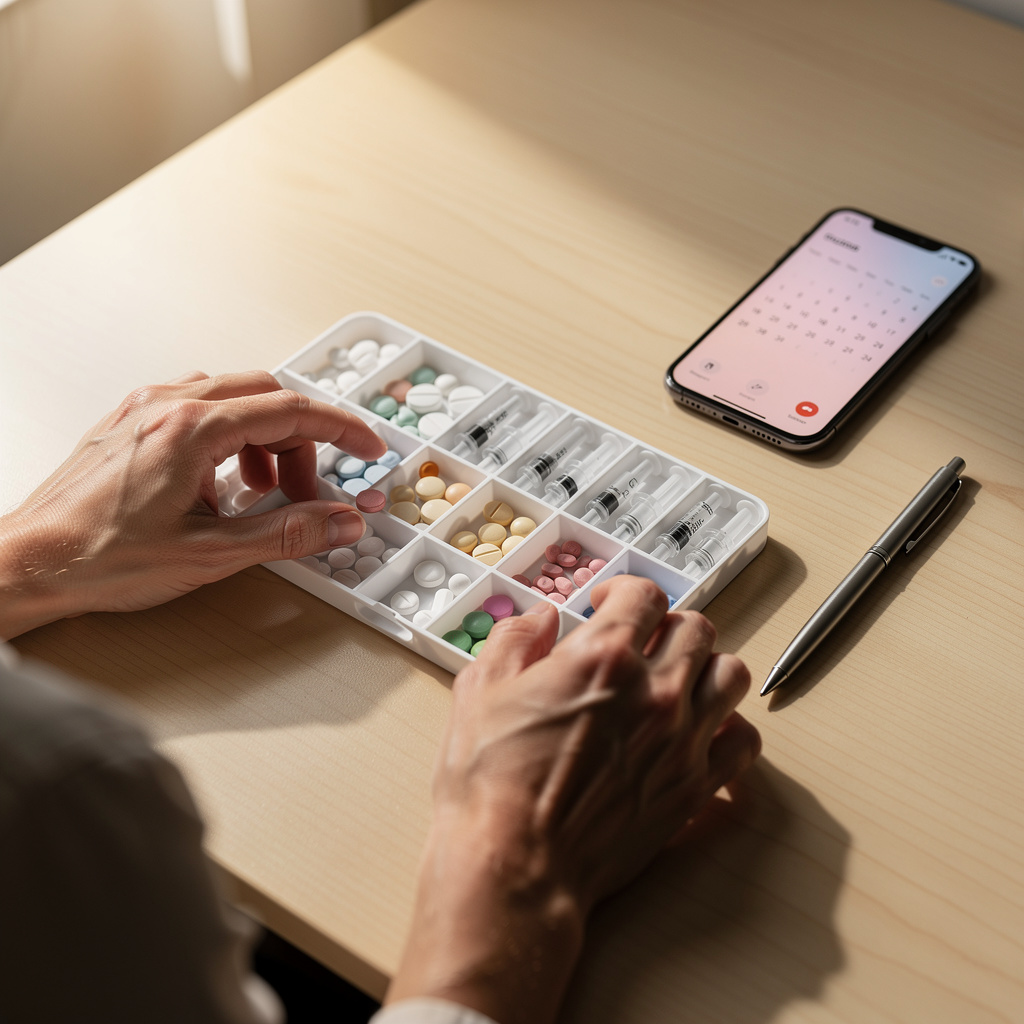
How to help your partner with fertility injections is concrete work: preparing doses, setting alarms, holding a hand through the injection, tracking injection site rotation, and having water and a blanket ready for the side effects that follow.
If a side effect worries either of you, write it down and ask the care team. You support the process, you do not adjust it.
On treatment and monitoring days, the non-patient partner takes the whole domestic load: no asking, no credit-seeking. Order food, run the errands, answer the relatives. Name the asymmetry once, out loud, so it stops becoming a silent scoreboard.
If sleep, alcohol, food or movement are being adjusted in your partner’s care, the change lands very differently when it is one person’s punishment and everyone else carries on as usual. The frame that works: change together.
You do not need this post for the science. Which lifestyle changes affect fertility, fertility-friendly daily habits, alcohol, caffeine and fertility and how sleep affects fertility cover that ground.
Your part is the framing: if something is being set aside, you set it aside too, at least in front of them. No “I am only doing this for you”, no martyrdom: it is a shared rule you both chose.
Together does not mean identical. Each of you keeps one unstressed thing: a hobby, a friend, a run. Protecting separate space protects the relationship, it does not threaten it.
The treatment schedule itself puts pressure on intimacy: in a study of 113 couples, more women than men said their partner did not understand how fertility affected them and worried they were drifting apart, while more men said the sex life lacked quality. The calendar is the culprit, not either of you. This is relationship advice with an evidence anchor rather than a clinical instruction.
The fertile window belongs to the protocol; the rest of the month belongs to you. Hugs, hand-holding, back rubs, shared shows, sitting close: none of it needs a reason, a schedule or a scorecard.
The sign to watch for: you only touch on “go” days. A weekly date with phones away, a rule that intimacy is never scored, and a line you can say out loud: “I want you, not just a cycle”. That is how to keep your relationship strong during fertility treatment, without one more item on the list.
Relatives rarely mean harm and still manage it. Agree in advance on who answers them and on the one-line script you both use. Your partner should never face the inquisition alone; the National Infertility Association’s guide covers how people outside the couple can help or hurt.
Prepare your responses and treat them as complete sentences. “We are focused on our health right now.” “We will share news when we have it.” You do not owe anyone a timeline. Holidays need an exit plan built together: decide which gatherings you skip without guilt, and protect the one or two you choose.
You are not a bystander, you are the second person in it. Partner distress and burnout are well documented, the discontinuation research describes couples rather than individuals, and counseling guidance from the ASRM’s Mental Health Professional Group names both partners.
This section is about you, without the self-care cliches: your support network, your outlets and your permission to be tired are part of how the process works, not a luxury. For your partner’s side, dealing with stress on the infertility journey and self-care on a personal infertility journey are written from the inside; share them. If your partner is male, men’s health and fertility covers his side.
Irritability, numbness, dread of appointment days, resentment toward your own life, fatigue that sleep does not fix, pulling away from friends. The honest line: you can be burned out and still love your partner completely. Burnout is a load problem, not a loyalty problem.
Keep one friend you can complain to about everything. Keep one physical outlet. Let yourself say “I am tired of this too” out loud, and you are allowed your own counseling session, alone, separate from any couples counseling.

Does my partner need therapy during fertility treatment? The honest answer is a decision the two of you make together based on signals, not a referral one person forces; the ASRM Mental Health Professional Group sets out what to watch for and how to choose someone trained in this area. The stakes are documented too: depression strongly predicts treatment discontinuation, and expanded counseling access is an explicit recommendation in the research.
Choosing a counselor is a support decision. Changing any part of treatment stays with the care team.
Signals to discuss, not a diagnosis: conversations about treatment reliably turn into a fight; either person has stopped sleeping or eating normally; one of you has withdrawn from everyone; either of you dreads the next appointment; or you disagree about whether to continue.
Look for a licensed clinician with graduate training in the psychological aspects of infertility, and ask about their experience with fertility patients first. Many clinics offer referrals or have mental health professionals on staff. Couples and individual counseling both work, and either of you can start alone.
To understand more about what your partner is going through, the posts on our blog cover the medical side and the day-to-day parts of the journey, and the infertility guides in our library go deeper on the medical topics. If today was hard, that does not mean you failed.
Showing up through treatment is one of the hardest support jobs there is, and you are allowed to find it hard. You will both be okay, whatever the outcome is, one week at a time.