30+ Years
of Medical Experience

You notice more hair in the shower drain than usual. Maybe it is on your pillow in the morning, or you catch your reflection and realize your hairline has shifted again. If this sounds familiar, you are not alone. Hair loss in men affects roughly two-thirds of men by age 35 and as many as 85% by age 50 (Hamilton, 1951, via PubMed).
Here is what most people miss. Hair loss is not just a cosmetic issue. While genetics account for the majority of male hair loss, thinning hair can also be one of the first visible signals that something is shifting internally. Your thyroid, hormones, nutrient levels, stress response, and even cardiovascular health can all show up on your scalp before they show up anywhere else.
Think of your hair as a barometer for internal health. This does not mean every thinning man has an underlying condition, but unexplained or accelerated hair loss deserves attention, not dismissal.
This guide walks through what the evidence says about the most important internal health signals connected to hair loss in men, what each one looks like, and what you can do about them.
Hair follicles are among the most metabolically active tissues in the body, second only to bone marrow (Mayo Clinic). That means they are sensitive to nearly everything happening inside you.
Each follicle cycles through three phases: anagen (growth), catagen (transition), and telogen (resting and shedding). This cycle is regulated by thyroid hormones, sex hormones, nutrients, and stress signaling. When your internal environment changes, follicles can be pushed into the resting phase prematurely, leading to shedding months later.
Sudden or unusual thinning can point to shifts in thyroid function, hormone balance, nutritional status, cortisol levels, or systemic inflammation. If your hair loss does not fit the typical pattern of gradual male pattern balding, it is worth investigating further. You can also explore silent autoimmune symptoms that most people ignore for context on how subtle internal shifts surface externally.
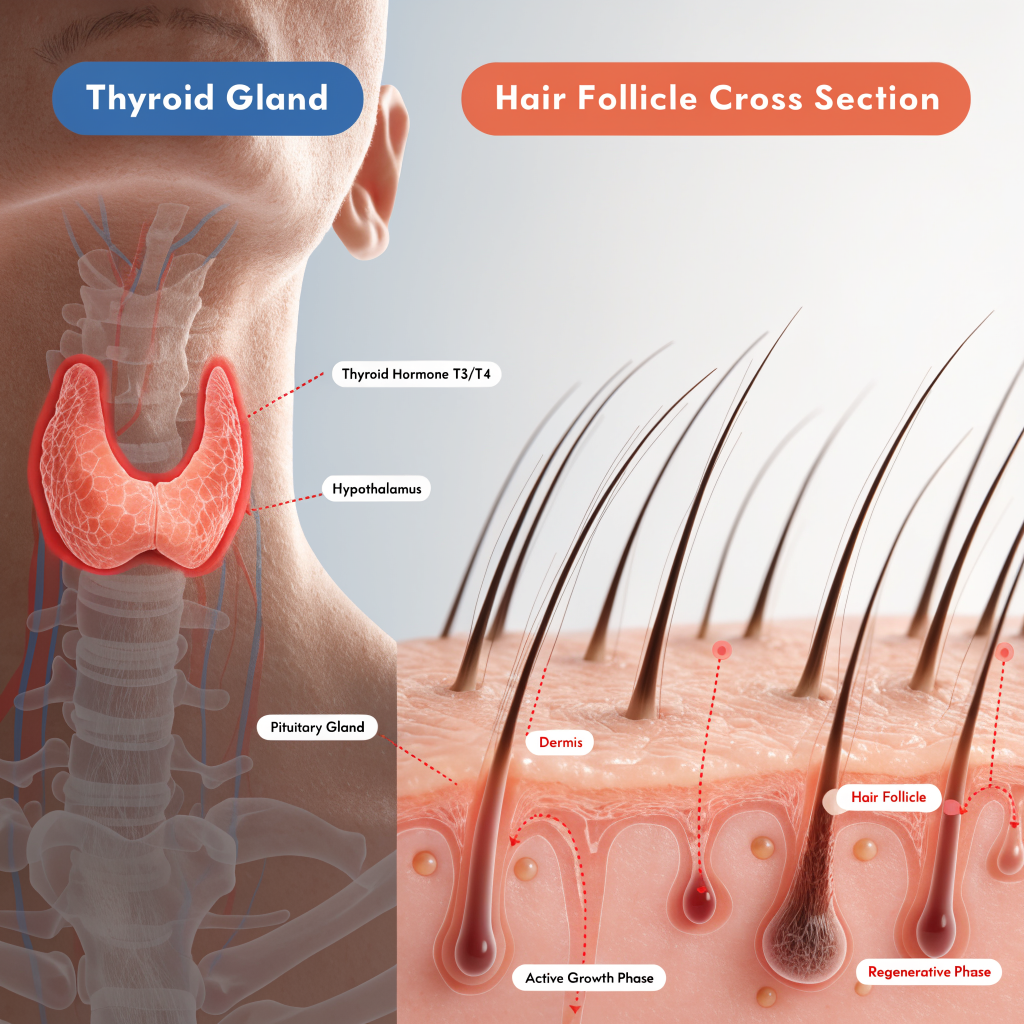
The thyroid gland produces hormones that regulate metabolism, energy, and your hair growth cycle. Both hypothyroidism (underactive) and hyperthyroidism (overactive) can cause hair thinning, and the connection is well documented (British Thyroid Foundation).
Thyroid hormones T3 and T4 help regulate the follicle growth cycle. When levels are too low or too high, follicles are pushed into the shedding phase early, causing diffuse thinning across the scalp rather than the patterned loss seen with male pattern balding.
Here is the catch: hair loss from thyroid dysfunction typically appears several months after the imbalance begins, making it easy to overlook. If thyroid issues are on your radar, testing matters.
Standard TSH screening catches many cases, but comprehensive thyroid testing beyond TSH (including free T3, free T4, and antibodies) gives a fuller picture. Because chronic stress can disrupt thyroid health, the two often travel together.
A 2024 PMC study also found links between ferritin, TSH, and androgenetic alopecia (PMC study). Supporting your thyroid through nutrition, as covered in foods for thyroid health, is a practical first step.
When most men think about hair loss and hormones, they think about one thing: testosterone. Here is the reality, and it surprises a lot of people. Does balding mean low testosterone? No. In fact, the opposite is closer to the truth.
Male pattern baldness, or androgenetic alopecia, is driven by dihydrotestosterone (DHT), a potent derivative of testosterone. DHT binds to androgen receptors in susceptible follicles, causing them to miniaturize over time until growth stops (MedlinePlus).
What matters is not your total testosterone level, but how sensitive your follicles are to DHT. That sensitivity is largely genetic. A man with normal or high testosterone can still experience significant hair loss if his follicles are highly responsive. This is why Harvard Health’s guidance on treating hair loss in men focuses on blocking DHT locally rather than correcting testosterone levels.
Hormones do shift with age, however. Natural testosterone decline begins gradually after 30 and can influence hair density alongside fatigue and reduced muscle mass.
If you are noticing hair thinning along with energy or mood changes, explore male hormone changes by age and discuss a full hormone panel with your provider. For some men, hair thinning is one of the signs that BHRT at 40 may be worth evaluating.
Hair is made of keratin, a protein, and building it requires a steady supply of vitamins and minerals. When those supplies run low, hair is often one of the first tissues to suffer. Here is what the evidence supports.
Iron (ferritin). The link between iron deficiency and hair loss is well established. Iron is essential for hemoglobin production and oxygen delivery to follicles.
Cleveland Clinic notes that hair shedding may be the first symptom patients notice before other signs of iron deficiency anemia appear (Cleveland Clinic). Ferritin testing, which measures iron stores, is a straightforward blood test.
Zinc. Zinc deficiency can impair follicle function and has been linked to telogen effluvium. However, evidence for zinc supplementation in people who are not deficient is weak (PMC review). Testing first, supplementing second, is the sensible approach.
Vitamin D. Low vitamin D levels are associated with both androgenetic alopecia and telogen effluvium. A large share of adults fall short of recommended levels, making it a common and correctable contributor.
Biotin. Despite heavy marketing, the evidence does not support biotin supplementation for hair loss in people who are not genuinely deficient. True biotin deficiency is rare, and high-dose biotin can interfere with important lab tests, including thyroid and cardiac markers (Harvard Health).
Protein. Inadequate dietary protein can trigger shedding. If you have significantly reduced calorie or protein intake, whether through dieting or illness, expect hair to respond.
The practical move is targeted testing rather than guessing with supplements. A comprehensive micronutrient deficiency testing panel identifies what you actually need. For broader context on men’s nutritional health, see essential nutrients to boost men’s health naturally.

Can stress cause hair loss in men? Yes, and the mechanism has a name: telogen effluvium. It is one of the most common causes of sudden, diffuse shedding, and it is directly linked to the stress response (NHS).
When you experience significant stress, whether physical (illness, surgery, rapid weight loss) or emotional (job loss, grief), your body ramps up cortisol through the hypothalamic-pituitary-adrenal (HPA) axis. Elevated cortisol pushes follicles from the active growth phase into the resting phase. Two to three months later, you start shedding more hair than usual (American Academy of Dermatology).
That delay is the confusing part. You might feel fine by the time the hair starts falling out, making it hard to connect the shedding to the original stressor. If you got sick in January and noticed shedding in March, the timeline actually makes perfect sense.
The encouraging news: most cases resolve on their own within 6 to 9 months once the stressor passes. Chronic stress, however, can prolong the cycle.
Managing stress is not just good for your mental health; it is a direct input to hair recovery. Practices like daily mindfulness, regular walks, and breathwork make a measurable difference.
If you want a starting point, training emotional resilience in 5 minutes a day is a practical framework. And because stress and hormones are tightly linked, addressing chronic stress and low T often helps on both fronts.

This is the section that tends to get attention, and for good reason. A growing body of research links androgenetic alopecia, particularly crown or vertex balding, with increased cardiovascular risk. Balding and heart disease risk is an active area of study, and the findings are worth understanding.
One PMC study examined men with androgenetic alopecia aged 25 to 40 and found significantly higher LDL, VLDL, and triglyceride levels, along with lower HDL, compared to men without AGA (PMC3853891). The researchers concluded that evaluating AGA cases for coronary artery disease risk factors can help prevent future disease.
A larger prospective study of 1,380 men found that androgenic alopecia, premature graying, and hair thinning were independent predictors of coronary artery disease in men under 40 (PMC6768519). That is striking for a demographic that rarely thinks about heart risk.
Important nuance: association is not causation. AGA and coronary artery disease may share underlying mechanisms, including insulin resistance, chronic inflammation, and androgen sensitivity, rather than one directly causing the other. Hair loss and diabetes risk may travel together through those same pathways.
Practically speaking, early vertex balding may be a visible risk marker worth discussing with a doctor, especially if other metabolic risk factors are present. It is not a diagnosis or a reason to panic. It is a reason to be proactive.
If you are noticing crown thinning alongside other risk factors, a preventive screening conversation makes sense. Our guide to men’s preventive health screenings by age can help you know what to ask for, and cardiovascular health and brain aging explains why heart health matters far beyond the heart.

Knowing what to look for helps you distinguish between typical pattern balding and hair loss that may signal something internal. The two often look quite different.
Common early patterns of male pattern baldness include a receding hairline at the temples (Norwood Type I or II), thinning at the crown (vertex), or gradual overall thinning. This loss is slow, predictable, and follows a recognizable pattern over years (Cleveland Clinic).
Health-signal hair loss looks different. Watch for sudden onset, patchy loss, or shedding accompanied by unexplained fatigue, weight changes, digestive issues, cold intolerance, or mood changes. Hair loss that began after starting a new medication also warrants a provider conversation.
When you see a doctor, asking for the right tests makes the visit productive. A useful baseline panel includes TSH (with free T3 and free T4 if indicated), ferritin, vitamin D, zinc, a complete blood count, total and free testosterone, and DHT.
If chronic stress is a factor, cortisol testing adds another layer. Our guide to specialty lab tests explains how to evaluate whether expanded testing is worth pursuing.
Yes. Stress-induced hair shedding, called telogen effluvium, is well documented. The key differentiator is the timeline: hair loss typically begins 2 to 3 months after the stressful event, and the shedding is diffuse (all over the scalp) rather than patterned. Most cases resolve within 6 to 9 months once the stressor is addressed (NHS).
No. This is a common misconception. Balding is driven by how sensitive your follicles are to DHT (dihydrotestosterone), not by your total testosterone level. Men with normal or high testosterone can still experience significant hair loss if their follicles are genetically susceptible to DHT (MedlinePlus).
A comprehensive baseline includes TSH (with free T3 and T4 if indicated), ferritin (iron stores), vitamin D, zinc, complete blood count, total and free testosterone, and DHT. If chronic stress is a suspected factor, cortisol testing adds useful information. The right panel depends on your symptoms and history, so a conversation with your provider is the best starting point.
It depends on the cause. Telogen effluvium from stress or illness typically resolves once the trigger is removed. Thyroid-related hair loss usually improves once thyroid levels stabilize.
Androgenetic alopecia can be slowed with treatment but is generally not fully reversed. The earlier you identify the cause, the more options you have.
Hair loss in men is not just cosmetic. It can be an early visible signal of internal health changes involving the thyroid, hormones, nutrient status, stress levels, or cardiovascular risk. The most common type, male pattern baldness, is genetic and driven by DHT sensitivity, not low testosterone. That distinction matters because it changes what you do next.
If you are noticing sudden, patchy, or unexplained hair loss, a medical workup makes sense. Blood tests for TSH, ferritin, vitamin D, zinc, and hormones can reveal correctable contributors. If stress is part of your picture, addressing it supports both your hair and your overall health.
The bottom line: hair loss is a sign to pay attention to, not a reason to panic. A holistic approach that considers nutrition, stress, thyroid function, and hormone balance supports both hair health and long-term well-being.
If you are noticing changes in your hair, talk to a healthcare provider about what your body may be telling you. For a closer look at how chronic stress and hormones interact, see chronic stress and low T.