30+ Years
of Medical Experience

Two facts about women’s health tend to travel in separate conversations: the first is that cardiovascular disease is the leading cause of death for women, and the second is that hormones change significantly during perimenopause and menopause. Few sources connect them, which is why estrogen and heart health in women can feel like a rumor you have never had explained.
This post connects them, in four steps: why women’s heart risk follows a different pattern across a lifetime, how estrogen acts on blood vessels, what the trials and their re-analyses found about BHRT and cardiovascular health, and how a clinician weighs it against your profile.
One promise up front: no fear, no guarantees, and no instruction to start or change anything on your own. This is general health information, not medical advice.
Cardiovascular disease is the leading cause of death for women, and the American Heart Association’s scientific statement on the menopause transition and cardiovascular risk says it plainly: this is not a man’s disease with a female footnote.
What makes the pattern sex-specific is that a woman’s risk is not static. It moves with pregnancy history, with contraceptive exposure, and most sharply with the menopause transition.
According to the CDC, over 60 million US women, about 44%, live with some form of heart disease, and only about 56% recognize cardiovascular disease as their leading cause of death.
The AHA statement describes the menopause transition as a period of accelerating cardiovascular risk. That describes a population, not any one reader, and it is why this conversation belongs in the women’s health library.
Another difference is presentation. Some women experience what researchers describe as atypical cardiac symptoms in women: shortness of breath, nausea, fatigue, or pain in the jaw or back, rather than the classic chest pressure that people picture from television.
These differences help you describe what you are feeling accurately to a professional, not diagnose yourself. If symptoms suggest a possible emergency, the right response is emergency care (call 911 or go to the nearest emergency department), not a scheduled appointment.

Here is the science this post exists for. Estrogen does not act on the heart as a single on-off switch. It acts on the inner lining of blood vessels, on cholesterol handling, and on inflammatory signaling.
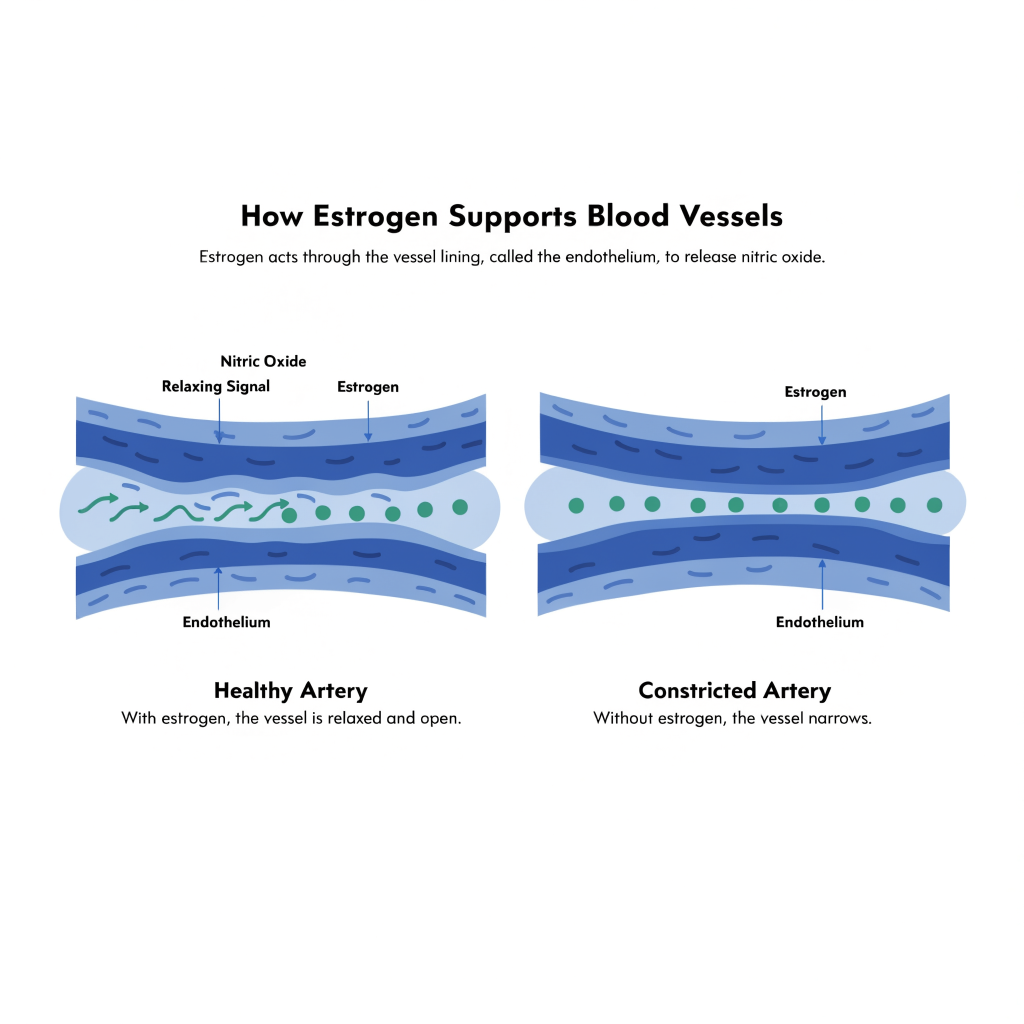
Estrogen supports the endothelium, which produces nitric oxide, which drives vasodilation, which sets vascular tone, with lipid handling and inflammatory signaling running alongside. Each link gets its own section below.
One scope note: this section is about endogenous estrogen, the kind your ovaries produce. Contraceptive estrogen exposure is a different cardiovascular story, with its own doses and literature.
The endothelium is the single cell layer lining every blood vessel. It decides, moment to moment, whether a vessel dilates or constricts, setting the tone of the entire circulation.
When estrogen binds to receptors in endothelial cells, it increases the bioavailability of nitric oxide, a molecule that tells the vessel wall to relax and widen, like a steady “relax” signal. Research on aging women and their endothelium documents this estrogen-mediated increase in nitric oxide bioavailability, along with attenuation of oxidative stress and inflammation.
The same research makes two points. Endothelial dysfunction precedes cardiovascular disease, showing up before clinical disease does, and endothelial vasodilator function declines rapidly across the menopause transition, independent of chronological age and tied to estrogen deficiency.
The second track is chemical. Estrogens influence the lipid profile (LDL, HDL, triglycerides) and markers of vascular inflammation such as C-reactive protein. A peer-reviewed review of menopause and women’s cardiovascular health describes these as core parts of estrogen’s vascular reach.
Two less familiar names sit in the same estrogen-sensitive axis: adiponectin, a protein involved in how the body handles fats and glucose, and homocysteine, an amino acid linked in research to vascular function.
Lipids and inflammation are not the whole story. The endothelium is where these effects meet, so a clinician reads your numbers as a system rather than a single value.
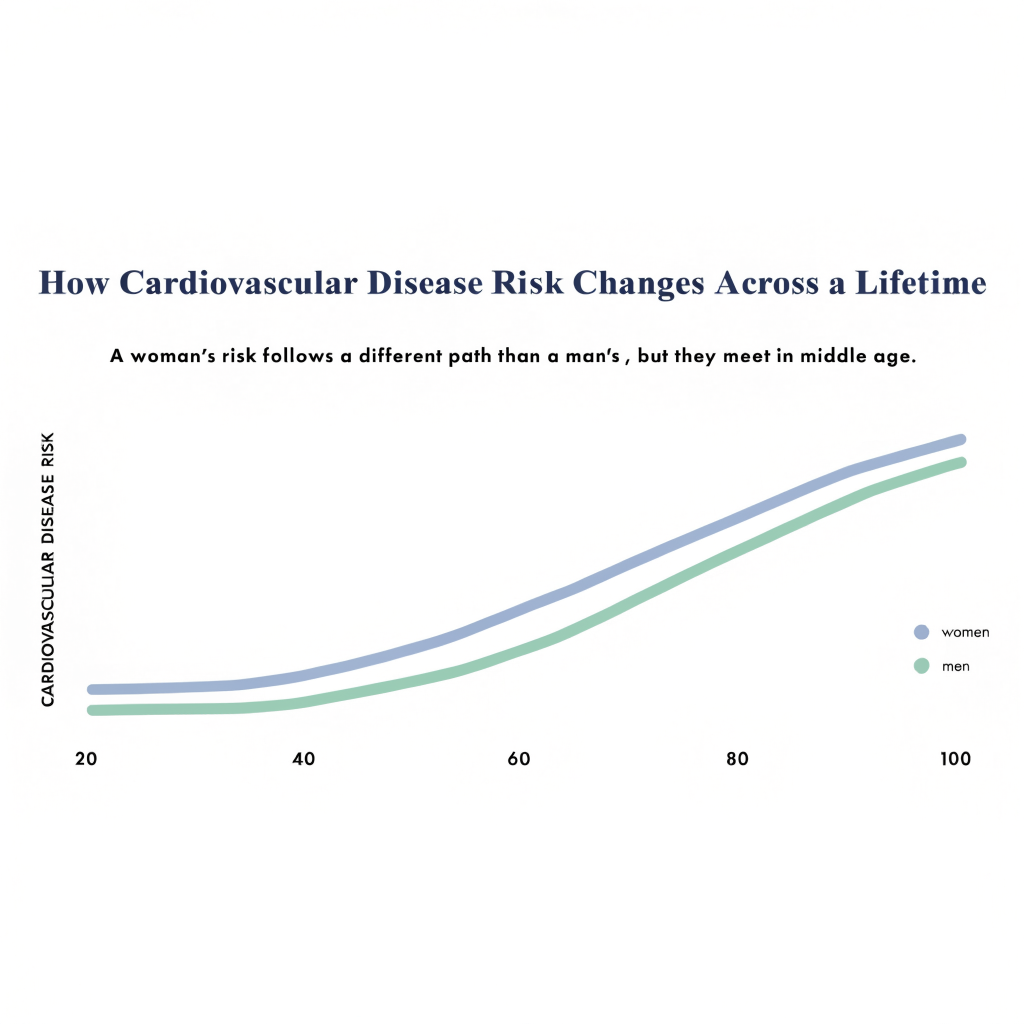
Before menopause, women on average have a lower incidence of cardiovascular events than men of the same age. That is the premenopausal protective curve, a well-known pattern in cardiovascular epidemiology, and after the menopause transition the curves converge.
The mechanism follows from everything above. Ovarian estradiol falls, the endothelial, lipid, and inflammatory support it provided declines with it, and cardiovascular risk factors rise across the transition, a pattern documented by the AHA statement and the endothelium research cited earlier.
Read that carefully: this is a population-level association, not a guarantee that every woman’s risk moves the same way. A population curve is never a personal forecast.
Researchers also measure structure, not just function. Carotid intima-media thickness, a scan-based measure of artery wall thickness in the neck, is used as an early marker of vessel wall change.
The transition sits inside a wider picture: hormone shifts across the life stages and our menopause management guide both cover the ground around it.
Now the part everyone searches for, so the frame matters first: trials measure populations, and a population finding is not a personal prediction. Every number in this section describes groups in studies, not a forecast for you.
Two kinds of evidence often get blended together. Evidence for symptom relief from hormone therapy is strong and well established. Evidence about cardiovascular outcomes is more complex, depends on age and timing, and is still being refined. The broader BHRT safety debate is covered in depth separately, and the wider symptom-relief picture of BHRT is summarized in a separate guide. This post adds the vascular mechanism that debate rests on.
The Women’s Health Initiative is the trial most people have heard of. In the estrogen-plus-progestin arm, the 2003 New England Journal of Medicine report found that hormone therapy did not reduce coronary heart disease in the cohort studied, a group older on average than women asking about therapy.
The picture changed when researchers looked at the data by age and years since menopause. That re-analysis, published in JAMA in 2007, found that cardiovascular outcomes varied with time since menopause rather than behaving like a uniform therapy effect. It did not overturn the trial; it added a dimension the original framing had flattened.
More recent work adds nuance: a December 2025 analysis from Northwestern’s Feinberg School of Medicine reported that hormone therapy did not increase cardiovascular disease risk in younger postmenopausal women. Read it as a population-level finding with the same caveat as everything else here, not a green light.
The honest answer is that it is more complicated than yes or no. Estrogen supports blood vessel function through several pathways, and some evidence associates early initiation of hormone therapy with lower cardiovascular risk, but no study shows that hormones guarantee protection for any individual woman. Protection language oversteps the evidence: the open research question is how estrogen’s vascular effects play out with age, timing, and route.
The most discussed idea here is the timing hypothesis, or window of opportunity: initiating hormone therapy earlier, within roughly six years of menopause and before age 60, may carry different cardiovascular associations than starting later, as a landmark review by Hodis and Mack lays out.
That review reports a meta-analysis of randomized trials showing about a 32% lower rate of coronary heart disease events in women younger than 60 or within 10 years of menopause, with a null effect in older women. Those halves travel together, and a systematic review of the timing hypothesis treats the pattern as an open question rather than a settled verdict.
Why does timing matter? Part of the answer is cumulative hormone exposure: it is not only whether therapy is used, but how long and at what stage of vascular aging. The timing hypothesis remains a hypothesis: randomized data in younger women are limited, and the 32% figure is a population association, not a personal promise.
Route enters the mechanism chain at the liver. Oral estrogen passes through it first (first-pass metabolism), which can raise clotting-related proteins. Transdermal delivery bypasses that pass, and that difference is why route is studied as a modifier of venous thromboembolism risk.
The numbers come from a 2019 BMJ study covering more than 80,000 venous thromboembolism cases: oral hormone replacement was associated with an adjusted odds ratio of 1.58 (95% CI 1.52 to 1.64) versus no exposure. Transdermal products were not associated with a materially elevated risk in the same data. That is a lower association in an observational study, not a statement that any route is risk-free.
For a fuller comparison, see the natural vs bioidentical hormones guide and our guide to choosing the right BHRT delivery method. Route decisions belong to a clinician who knows your history.
Premature ovarian insufficiency, or POI, means menopause before age 40, when the ovaries stop producing estrogen earlier than expected.
The evidence is specific: A 2023 systematic review and meta-analysis found POI associated with higher cardiovascular risk, with a pooled adjusted hazard ratio of 1.35 (95% CI 1.06 to 1.63) for composite events and 1.42 (95% CI 1.17 to 1.66) for coronary heart disease versus usual-age menopause.
That makes POI a natural experiment in early, sustained estrogen loss, which is why researchers study it separately rather than folding it into the average.
Some medical guidance discusses hormone therapy until the usual age of menopause for women with POI, since the body is missing estrogen it would ordinarily still have. Whether that applies to you is a clinician’s case-by-case decision, and nothing here is a reason to start, stop, or change prescribed therapy on your own.
There is no blanket recommendation here. A clinician weighs each woman’s risk profile, menopause stage, symptoms, personal history, and family history against the evidence above.
Your role is not to arrive having decided anything. Bring accurate information: your history, your family’s history, your symptoms, and good questions.
Whatever the hormone conversation, some factors carry weight on their own: blood pressure, lipid levels, blood sugar, smoking history, and family history. Research associates smoking with higher cardiovascular risk, for instance, which is a statement about association in populations, not a verdict on anyone’s past choices.
Screenings remain the baseline for catching them early, and regular exercise supports heart health at any hormone stage, while sedentary time is an independent risk factor in its own right. Sleep and stress touch the same hormonal system. When numbers need clarifying, specialized lab testing can clarify hormone and cardiovascular markers.
Here are plain-language questions for your own clinician, not a checklist to follow alone:
If getting that conversation on the calendar is the sticking point, a telemedicine consultation is a low-friction first step to discuss your individual risk and hormone questions.

In short:
If your own heart health and hormone questions feel connected, the right next step is a conversation with a healthcare provider who can look at your full picture. Our guide on signs you could benefit walks through that eligibility conversation.
For more, see more from the BHRT library or browse all articles. This article is informational and is not a substitute for medical advice.