30+ Years
of Medical Experience

Have you ever walked into a room and forgotten why you were there? Or drawn a blank on a colleague’s name moments after being introduced? Memory lapses are one of the most common frustrations people face, especially as we juggle work, family, and personal growth.
The good news is that memory is not a fixed trait. It is a skill that can be strengthened with the right approach. Cognitive techniques for better memory are evidence-based strategies that help your brain encode, store, and retrieve information more effectively. In this guide, you will learn nine of them, backed by peer-reviewed research.
Cognitive techniques for better memory are evidence-based mental strategies that help the brain encode, store, and retrieve information more effectively. They include active recall, spaced repetition, mnemonic devices, the memory palace (method of loci), chunking, elaborative interrogation, dual coding, interleaving, and the Feynman technique.
Research consistently shows that these methods can improve long-term retention by 50 to 200 percent compared to passive review. In one landmark study, Roediger and Karpicke found that students who practiced retrieval retained significantly more material after one week than students who simply restudied the same content (Roediger & Karpicke, 2006).
What makes these techniques different from everyday memory advice is that they target specific cognitive processes. They are not about working harder; they are about working with the way your brain naturally learns.
Every memory goes through three stages: encoding (getting information in), consolidation (stabilizing it), and retrieval (pulling it out when needed). Cognitive techniques target one or more of these stages. Active recall strengthens retrieval. Spaced repetition optimizes consolidation timing. The memory palace enhances encoding through spatial associations.
Neuroplasticity, the brain’s ability to form new connections throughout life, is the foundation for why these techniques work. Neuroplasticity allows the brain to rewire itself based on experience, and cognitive techniques are one of the most direct ways to harness that process. When you actively retrieve information, you strengthen the neural pathways associated with that memory, making it easier to recall in the future.
Without active intervention, the brain follows a different pattern. The Ebbinghaus forgetting curve shows that we forget roughly 50 percent of new information within an hour and up to 70 percent within 24 hours. Passive review creates an illusion of competence: you recognize the material, so you think you know it, but recognition is not the same as recall. As Karpicke and Roediger demonstrated, the act of retrieval itself is one of the most powerful learning events the brain can experience (Karpicke & Roediger, 2008).
Active recall is the act of pulling information from your memory without looking at the source material. Instead of rereading notes, you close the book and try to remember the key points. Instead of scanning flashcards, you force yourself to produce the answer before flipping the card over.
The research on this technique is among the strongest in all of learning science. Dunlosky and colleagues rated practice testing as one of only two techniques with high utility for improving learning (Dunlosky et al., 2013). In Roediger and Karpicke’s study, students who practiced retrieval retained 50 percent more material one week later compared to students who restudied.
You do not need any special tools. After reading an article, pause and write down everything you remember. After a meeting, take 60 seconds to mentally review the main decisions and action items. Each retrieval attempt strengthens the memory trace. For a deeper dive, explore our guide on active recall and spaced repetition techniques.
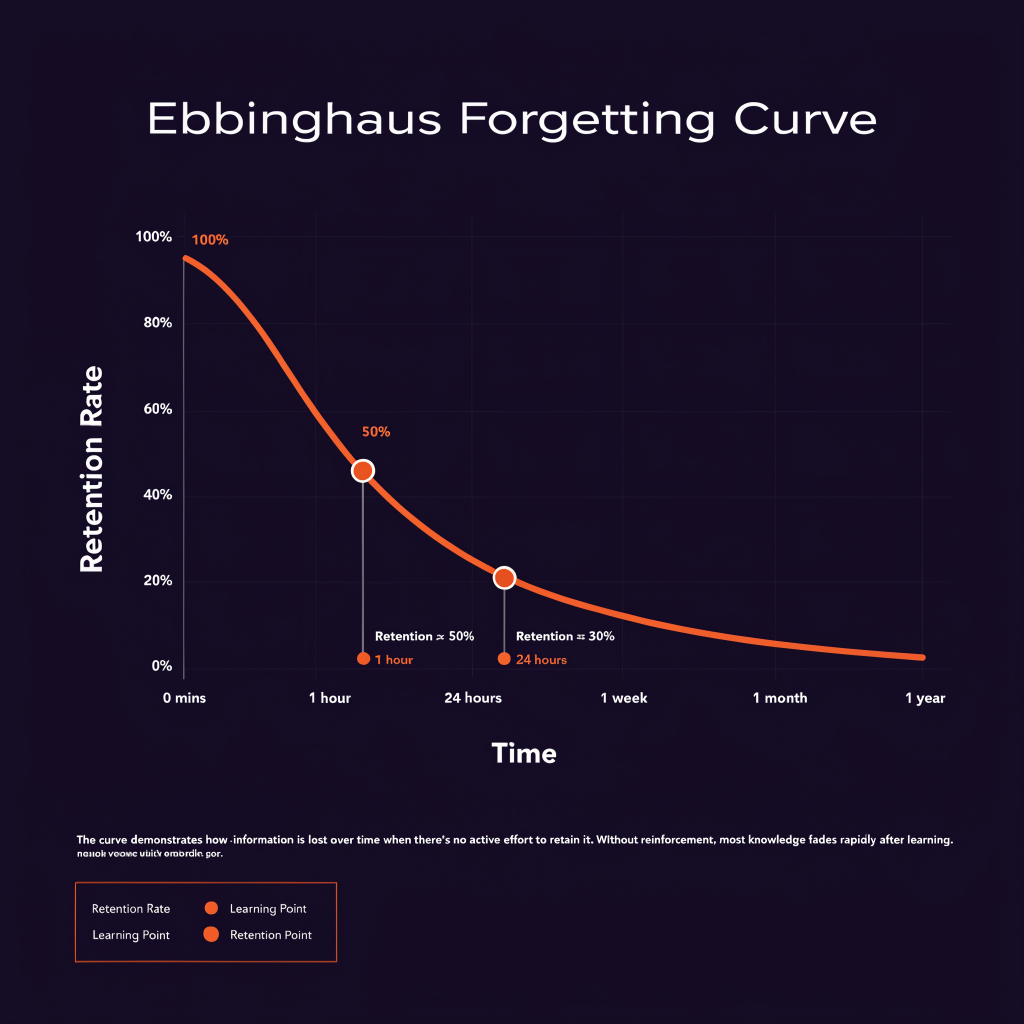
Spaced repetition is the practice of spreading your study sessions over increasing intervals rather than cramming. The spacing effect, one of the most robust findings in memory research, shows that information is retained far better when review sessions are separated by days or weeks.
Research by Cepeda and colleagues found that the optimal gap between study sessions is roughly 10 to 20 percent of the desired retention period. Want to remember something for a week? Space your reviews about one day apart. Want to retain it for a year? Space them about three weeks apart (Cepeda et al., 2008).
Each retrieval after a period of forgetting signals to your brain that this information is important. The memory trace becomes stronger and more resistant to decay. Cramming, by contrast, creates short-term familiarity that fades quickly. Use a spaced repetition app like Anki, or simply schedule review sessions at increasing intervals: one day, three days, one week, then one month.
The memory palace is a 2,500-year-old technique that uses spatial memory to help you remember ordered lists and sequences. You mentally place items along a familiar route, such as the rooms of your home or your daily commute.
Here is how it works. Choose a route you know well, like your home. Pick five to ten specific locations: the front door, the hallway, the kitchen table. For each item you want to memorize, create a vivid, exaggerated mental image and place it at one of those locations. To remember a grocery list, picture a giant carton of eggs crashing through your front door and a bottle of milk pouring over the hallway.
Brain imaging studies confirm why this works. The memory palace technique activates the hippocampal and parahippocampal regions, the same areas involved in spatial navigation (Maguire et al., 2003). By linking abstract information to spatial locations, you create an additional retrieval pathway. This technique is especially useful for memorizing speeches, presentations, and ordered sequences.

Mnemonic devices are systematic strategies for encoding and recalling information through associations. They come in several forms: acronyms (like HOMES for the Great Lakes), acrostics (such as “My Very Educated Mother Just Served Us Nine Pizzas” for the planets), visual imagery, and rhyme or rhythm (“In 1492, Columbus sailed the ocean blue”).
Mnemonics work because of a principle called dual coding: the information is stored both verbally and visually, creating two retrieval pathways. However, research rated keyword mnemonics as low utility for long-term learning because effects tend to be limited to short retention intervals (Dunlosky et al., 2013). They are excellent for short-term recall of facts, lists, and names, but work best when paired with active recall and spaced repetition for durable memory.
Chunking is the process of breaking large amounts of information into smaller, meaningful groups. You probably use it every day without thinking. Phone numbers are chunked into groups (555-123-4567) rather than presented as ten individual digits.
The classic research behind this technique comes from George Miller’s 1956 paper, “The Magical Number Seven, Plus or Minus Two.” Miller demonstrated that working memory holds roughly seven items at a time. Chunking expands your effective capacity by packing more information into each mental “slot.” In practical terms, this means organizing notes into categories, outlining complex material into three to five main categories with sub-points, and grouping learning material by theme.
Elaborative interrogation is the practice of generating explanations for why facts are true, rather than simply accepting them. When you ask “why does this make sense?” you connect new information to knowledge you already have, creating additional retrieval pathways.
Consider a concrete example. Instead of memorizing that “spaced repetition improves memory,” ask: “Why would spacing out practice improve memory?” The answer, because each retrieval attempt strengthens the neural pathway, gives you a deeper understanding. Research rated this technique as moderate utility (Dunlosky et al., 2013). It works best when you have prior knowledge on the topic, as this gives your brain more material to connect with.
Dual coding is the practice of combining verbal information with visual representations to create two separate memory traces. Allan Paivio’s dual coding theory established that the brain has two distinct but interconnected systems: one for verbal information and another for visual and spatial information (Paivio, 1991). When you encode information in both systems, you create more retrieval pathways and increase the likelihood of remembering.
The practical applications are straightforward. When reading, draw a rough diagram alongside your notes. Use mind maps to connect related ideas. Create flowcharts for processes. Sketch visual analogies when learning abstract concepts. You do not need to be an artist; even a simple sketch strengthens the memory.

Interleaving is the practice of mixing different topics or types of problems within a single study session, rather than focusing on one at a time. It feels less efficient during practice, but research consistently shows it produces stronger long-term results.
When you practice one topic exclusively, your brain settles into a pattern without much effort. Mixing topics forces your brain to constantly retrieve the correct approach, strengthening discrimination between concepts. Research has shown that after one day, interleaved practice outperformed blocked practice by 25 percent. After one month, the advantage grew to 76 percent (PMC, 2021). Mix practice problems from different chapters, alternate between related skills, and vary your learning topics within a session.
The Feynman technique is a four-step method: choose a concept, explain it in plain language as if teaching a child, identify the gaps in your explanation, and return to the source material to fill those gaps.
This technique works because it combines retrieval practice (explaining from memory) with self-explanation (identifying and addressing your own knowledge gaps). A meta-analysis of 64 studies found that self-explanation produces a significant learning improvement, with an average effect size of g = 0.55, which is considered moderate to large in educational research (Bisra et al., 2018). The moments where you stumble or hesitate are your knowledge gaps, exactly the areas you need to revisit. This technique is ideal for deep understanding, preparing presentations, and studying complex material.
Not sure where to start? This table gives you a quick overview of all nine techniques.
| Technique | How It Works | Best For | Difficulty | Evidence |
|---|---|---|---|---|
| Active Recall | Pull info from memory without cues | Long-term retention | Easy | HIGH |
| Spaced Repetition | Space practice over increasing intervals | Exam prep, long-term memory | Medium | HIGH |
| Memory Palace | Place items along a familiar route | Ordered lists, sequences | Medium | MODERATE |
| Mnemonic Devices | Create associations (acronyms, rhymes) | Facts, lists, names | Easy | LOW-MOD |
| Chunking | Group into meaningful units | Complex information | Easy | MODERATE |
| Elaborative Interrogation | Ask “why” to connect new to existing | Deep understanding | Medium | MODERATE |
| Dual Coding | Combine verbal and visual encoding | Processes, relationships | Medium | MODERATE |
| Interleaving | Mix practice topics within sessions | Complex skills, problem-solving | Medium | MODERATE |
| Feynman Technique | Explain simply, find gaps, fill them | Deep conceptual understanding | Medium | MODERATE |
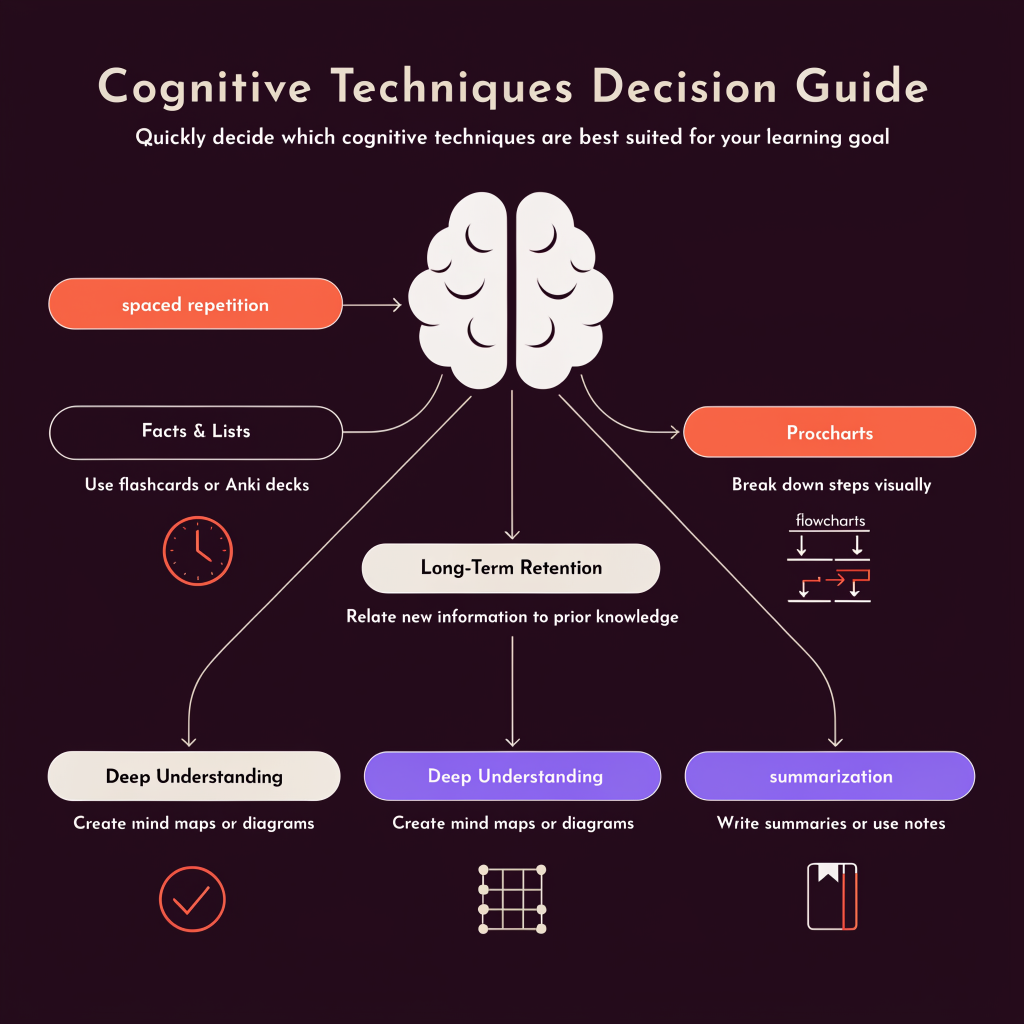
No single technique works for everything. Match your approach to your specific learning goals.
Use the memory palace or mnemonic devices. These techniques excel at encoding ordered sequences and discrete facts through vivid associations.
Combine active recall with spaced repetition. This pairing is the most evidence-backed combination for durable memory.
Use the Feynman technique with elaborative interrogation. Both methods push you to explain and connect ideas, building deeper comprehension.
Use dual coding. Combining verbal explanations with visual diagrams helps you see how parts of a process connect.
Use interleaving. Mixing related topics forces your brain to distinguish between concepts, strengthening discrimination and transfer.
Start with active recall. It requires no tools, no apps, and no special training. Pair it with spaced repetition as soon as you feel comfortable, and you will have a powerful foundation for preserving cognitive function with age.
One important note: cognitive techniques work best alongside foundational brain health practices. Sleep plays a critical role in memory consolidation, and combined with other lifestyle changes that support brain health (nutrition, exercise, and stress management), it creates the conditions in which these techniques perform at their best.
Memory is not a talent you are born with. It is a skill that improves with deliberate practice. Cognitive techniques for better memory work because they align with how your brain naturally encodes, stores, and retrieves information. The research behind these nine techniques spans decades of studies across neuroscience, psychology, and education.
If you remember nothing else, start using active recall today. It requires no tools, no special training, and no cost. Simply close the book and try to recall what you have just learned. Pair it with spaced repetition for maximum long-term retention, and layer in the other techniques as your practice grows.
Always build on a foundation of good brain health. For a deeper look at active recall and spaced retrieval, explore our guide on how to learn faster and remember more. And to understand how neuroplasticity supports cognitive growth, read about how to reshape your brain for better cognitive outcomes.