30+ Years
of Medical Experience

If you are in your 40s and have noticed your periods are less predictable than they used to be, or that you are waking hot at 3 a.m., you may have asked a question that sounds simple and is not: is this perimenopause, or is it menopause? In everyday conversation the two words are used interchangeably, but they describe different things.
This post walks through the distinction in four steps: what each stage means, the hormone shifts behind them, what to expect at each stage, and how to prepare for a conversation with your clinician.
A quick note before we begin: this is general health information rather than medical advice. Nothing here is a reason to start, stop, or change any treatment on your own.
Perimenopause is the transition leading to menopause, and it often lasts several years. Menopause itself is a single point in time, reached after 12 consecutive months without a period. Postmenopause is everything that follows that marker. One is a process, one is a milestone, and one is the chapter after it.
Perimenopause is the transition itself. For many women it begins in the 40s, and for some earlier (Mayo Clinic). The ovaries still produce estrogen, but erratically rather than in a smooth decline, and cycles become variable. Most symptoms people associate with menopause begin here. On average the transition runs about 4 to 8 years (Cleveland Clinic), with real variation between women.
Menopause is different in kind. It is not a phase you are in but a milestone you have passed, diagnosed once 12 consecutive months have gone by without a period (National Institute on Aging). In the United States the median age at menopause is about 52, with most women reaching it between 45 and 55. That is a population figure, not a prediction about any reader’s calendar.
Postmenopause is the stretch after that 12-month marker. Some women find hot flashes and night sweats ease over time. For others, changes such as vaginal dryness and urinary discomfort become more noticeable as estrogen remains low (Office on Women’s Health).
The formal dividing line is the 12-month amenorrhea rule: 12 consecutive months without a period. Many women assume menopause is diagnosed when periods first become irregular, but the threshold is strict, because cycles can stop for months and then resume. A bleed at month 11 resets the clock.
Menopause can only be confirmed in hindsight, which is what the rule is for (ACOG, NIA/NIH). Everything before it is perimenopause.
Knowing which part of the timeline you are on changes three practical things.
One mechanism is worth remembering: the transition is not a slow, straight fade. It is a volatile stretch that eventually becomes a decline. Researchers have documented estradiol swinging wide before it settles downward, alongside an earlier, steadier drop in progesterone (research on estradiol dynamics across the menopause transition).
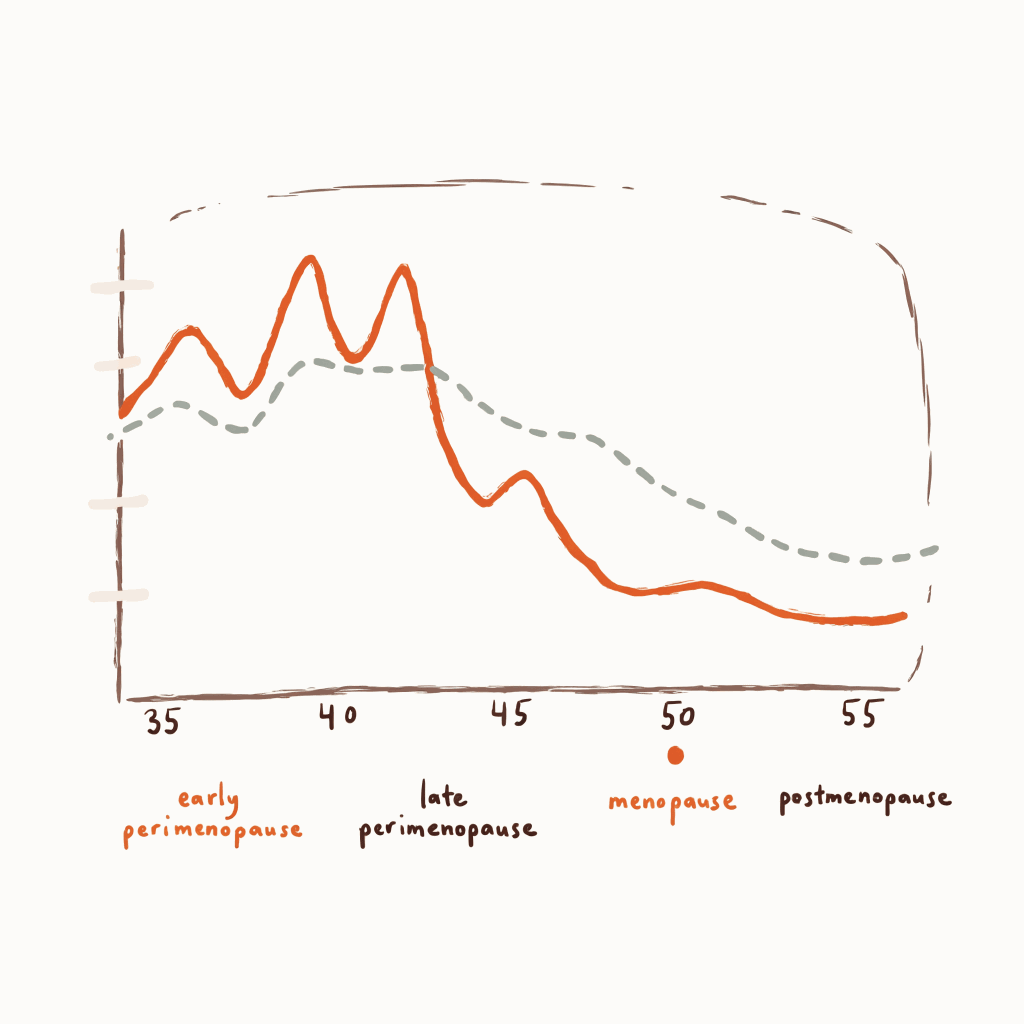
Many women picture estrogen falling in a straight line from their 40s onward. The reality is messier. During perimenopause, estrogen can rise higher than in the reproductive years and then drop sharply, sometimes within the same cycle. Harvard Health calls this stretch a rocky road rather than a glide path.
That volatility matters because the body responds to the swings, not only to the average. Wide fluctuations drive many early hot flashes, night sweats, sleep disruption, and the foggy concentration some women report. Later in the transition, estrogen begins a sustained decline that continues into postmenopause.
Progesterone follows a different script. It is produced after ovulation, so when ovulation does not happen, no progesterone follows; as anovulatory cycles become more common, it tends to decline earlier and more steadily than estrogen (the endocrinology of perimenopause).
For a stretch of years, progesterone is lower while estrogen is still swinging. Many women notice that shift in sleep quality, mood stability, and cycle regularity.
Researchers and clinicians label the stages of reproductive aging. The system most use is called STRAW+10, and it sorts the transition into early and late perimenopause, with postmenopause following the final menstrual period (the STRAW+10 staging framework). Early perimenopause typically begins in the mid-40s, though it can start earlier.
The defining feature of this stage is not a symptom but a change in timing. Ovulation still happens in some cycles, estrogen levels may look normal on average, and yet your cycle pattern has shifted.
The earliest detectable sign of perimenopause is a change in cycle length. A shift of 7 days or more from your usual pattern is the hallmark of early perimenopause (Cleveland Clinic). If your cycles were consistently 28 days for years, a 21-day cycle followed by a 35-day cycle is a meaningful signal, and it usually arrives before other symptoms do.
It is worth tracking: a few months of cycle dates often tells a clinician more than a single blood draw can.
An anovulatory cycle is a menstrual cycle in which ovulation does not occur. These cycles become more frequent as women approach menopause. Without ovulation there is no progesterone surge afterward.
That shift is one reason some women see heavier or more irregular bleeding, breast tenderness, or mood changes at this stage. Occasional anovulatory cycles are a recognized part of the transition (NHS). Bleeding that is very heavy, or any bleeding that worries you, is worth raising with a clinician.
Late perimenopause has its own signature: gaps of 60 days or more between periods, with some women skipping two or three months at a time. Fluctuations are more pronounced than in early perimenopause, and hot flashes and night sweats tend to become more frequent. Sleep disruption and mood changes may intensify with them.
This stage commonly lasts about 1 to 3 years, though it varies. One important feature: you cannot identify the final menstrual period as it happens; it is only recognizable afterward, once 12 months have passed without bleeding. Fertility remains possible during this stage, so contraception questions are worth raising with a clinician rather than assuming (NHS).
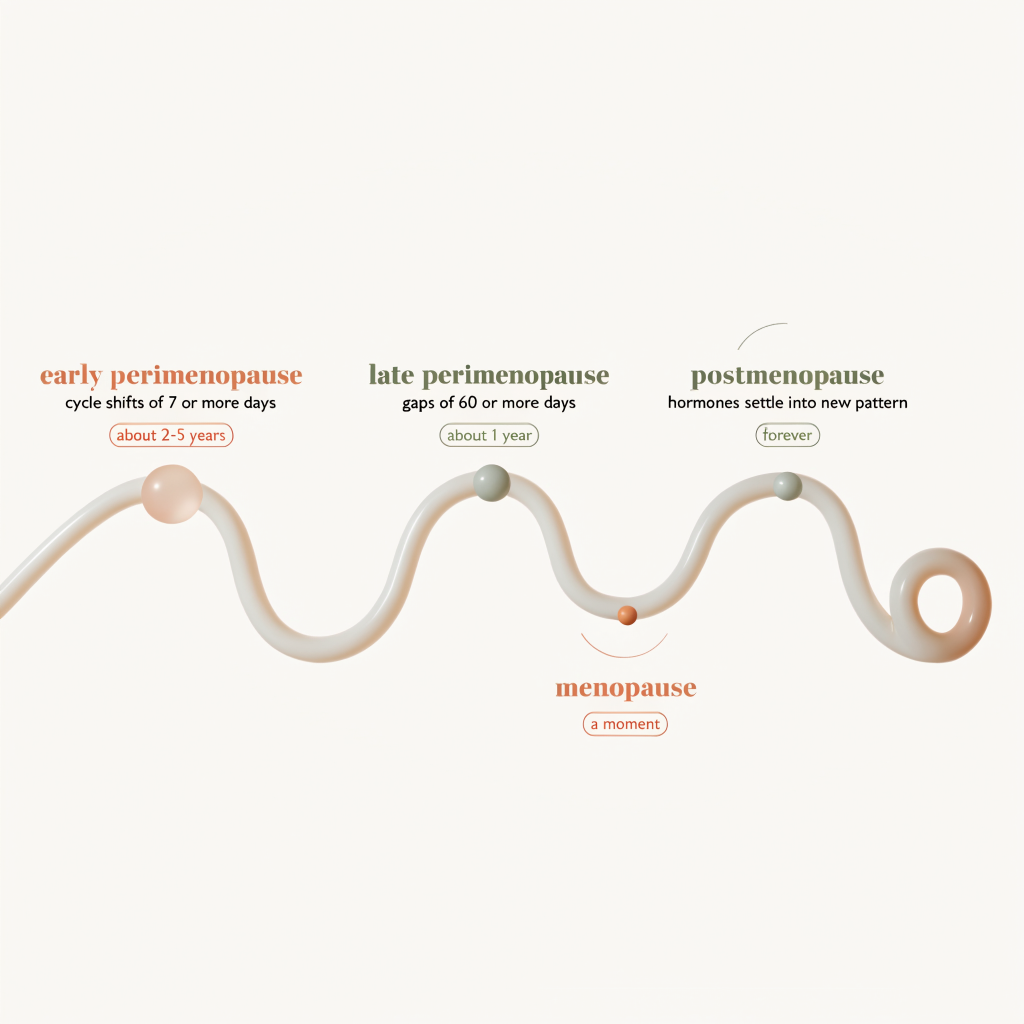
Menopause itself is a marker, not a phase. You are described as postmenopausal after 12 consecutive months without a period, and the year after that marker is one of continued adjustment.
Here the statistics and the lived timeline often pull apart. The median age at menopause in the United States is about 52 (NIA/NIH), while many women notice first changes in their mid-40s. The transition can carry someone past her 40s before she reaches the 12-month marker. Some women reach menopause before 45 and some after 55; those are population ranges, not any one reader’s timeline.
In the first year after the marker, some earlier symptoms such as hot flashes and night sweats ease for some women, while others, including vaginal dryness and urinary changes, may become more noticeable (Office on Women’s Health). Bone density and cardiovascular health start to matter more in this chapter, which is one reason to keep regular checkups.
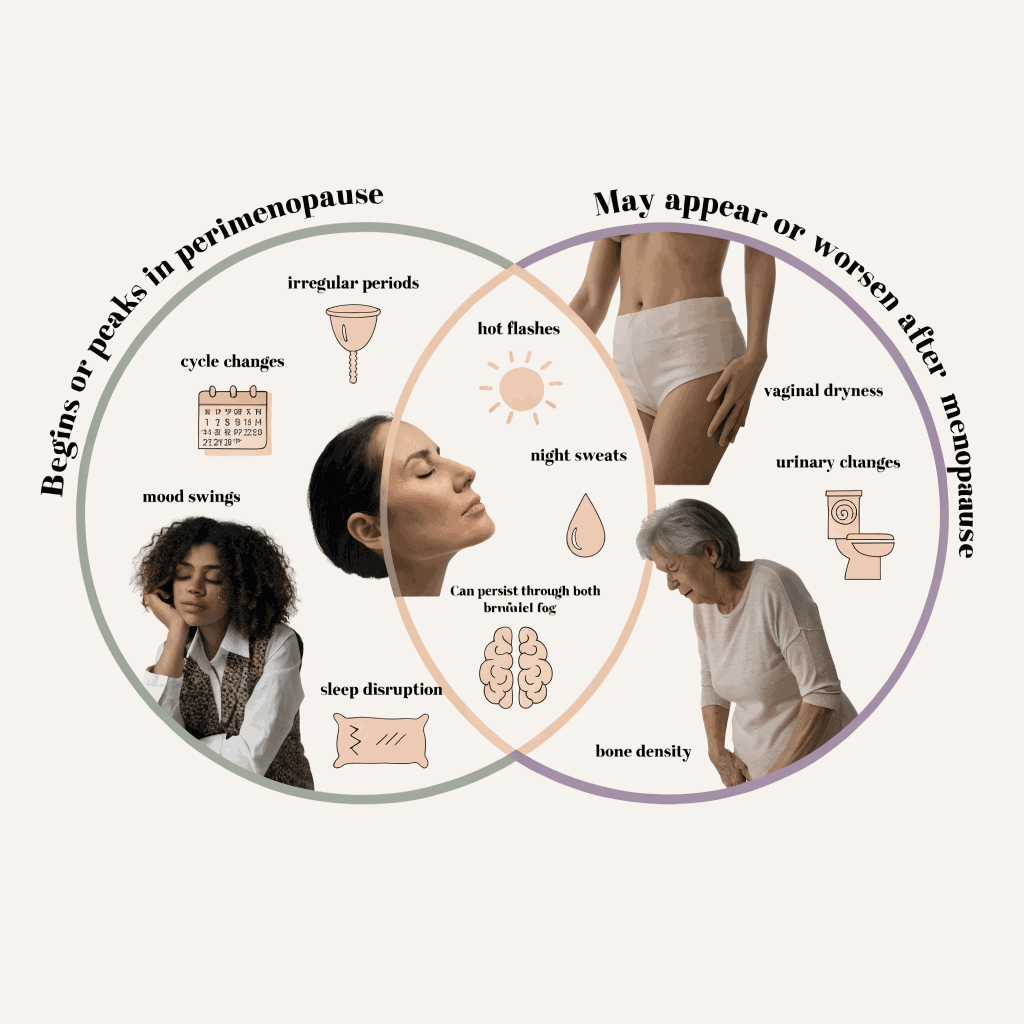
The symptom picture overlaps, but it is not identical on both sides of the line, and this map is a simplification.
| Pattern | Experiences |
|---|---|
| Commonly begins in perimenopause | Irregular or shifting cycles, heavier or lighter bleeding, hot flashes, night sweats, sleep disruption, mood swings, brain fog, fatigue, breast tenderness, anxiety |
| May appear or worsen after menopause | Vaginal dryness, urinary frequency or urgency, decreased libido, gradual bone density loss, changes in skin and hair |
| Can persist through both | Hot flashes, night sweats, sleep disruption, mood changes, brain fog |
The last row is the one people are least prepared for: some experiences begin in perimenopause and continue for years afterward. ACOG notes that symptom duration and intensity vary widely. Among women with frequent hot flashes and night sweats, one large US study put the median total duration at about 7.4 years (SWAN). Some women have few noticeable symptoms. Others find sleep, mood, or concentration takes a real toll on daily life. Neither end of that range is a personal failure.
Assessment follows a particular order, which helps you prepare.
First, your cycle history and symptoms. A clinician will usually ask when your cycles changed, what your pattern has looked like over the past year, and which symptoms affect sleep or daily function. That record is the primary tool.
Second, lab work with stated limits. Hormone levels can help rule out other explanations. Thyroid dysfunction, for instance, can look a great deal like perimenopause, and some symptoms overlap with those of perimenopause, as can mood conditions and sometimes pregnancy. Tests such as anti-Mullerian hormone may be used to estimate ovarian reserve when the picture is unclear.
One of the most common sources of confusion is a follicle-stimulating hormone (FSH) result. FSH generally rises as the ovaries become less responsive. During perimenopause, though, the ovaries still periodically produce estrogen, which pushes FSH back down into a normal range for a while. Hormone levels commonly fluctuate during perimenopause, so a result can read normal one week and elevated the next (Cleveland Clinic).
That is why many clinicians do not rely on a single FSH reading to diagnose perimenopause, and why no single blood test confirms it (Mayo Clinic). NICE guidance makes the same point: diagnose without lab tests after age 45, because FSH moves too much over short periods to help. A normal result can offer false reassurance, an elevated one false certainty. Your cycle pattern and symptom history carry more weight during the transition, while the 12-month rule remains the standard for confirming menopause.

Everything in this section is a topic for a conversation with your healthcare provider, not a protocol to start on your own. What fits depends on your symptoms, history, and individual risk profile.
Lifestyle measures. These are supportive foundations rather than cures. Nutrition that supports bone health (adequate calcium and vitamin D), regular physical activity, consistent sleep habits, and stress management are the measures most often discussed in clinical guidance (ACOG), and their effects vary from one woman to the next.
Symptom-directed options. Over-the-counter vaginal moisturizers are one option for dryness. Cognitive behavioral therapy has research support for menopause-related sleep problems and hot flashes, worth asking about if sleep is the main issue. If hot flashes, night sweats, and broken sleep are dominating your weeks, hormonal shifts can affect sleep quality, which is worth bringing up rather than absorbing quietly.
Clinician-directed hormone therapy. For moderate to severe symptoms, some women and their clinicians discuss hormone therapy as one option among several (NICE guidelines set out when it is appropriate), and bioidentical hormone therapy is one such option. Whether it is appropriate is an individual decision based on health history, timing, and risk factors, worked out with a professional rather than decided from an article. For a broader overview of symptom management, the comprehensive guide to menopause management and wellness covers that ground.
If getting an appointment is the sticking point, a telemedicine consultation can be a convenient way to discuss your symptoms and history.
Perimenopause is the process, menopause is the milestone measured 12 months after your last period, and postmenopause is the chapter that follows. Knowing where you may be on that timeline is not about labeling yourself; it is a way to make sense of what you are noticing and recognize when a conversation with a healthcare provider could help.
No two women move through this the same way. If your symptoms are disrupting your sleep or your days, that is enough reason to ask questions. Bring your cycle history and take the time you need to understand your options with a clinician who knows your story.