30+ Years
of Medical Experience

If you have ever caught yourself picking up your phone mid-conversation, or realized you have been scrolling for 30 minutes without remembering what you were looking for, you are not alone. Digital overload is reshaping the way our brains work, and its effect on attention span is measurable: the average person now spends over seven hours a day on screens, and that constant digital stimulation is quietly shrinking our ability to focus on a single task for more than a few seconds at a time.
In this article, we will explore what digital overload actually is, how it rewires your brain, what the research says about attention span decline, and how chronic screen stress may be disrupting your hormones in ways you have not considered. We will also give you a practical, science-backed plan to start reclaiming your focus.
Digital overload is the state of continuous information consumption from screens, notifications, social media, email, and streaming that exceeds the brain’s processing capacity. It happens when the volume and pace of digital input surpass what your brain can meaningfully process, leading to fatigue, reduced focus, and diminished well-being. Think of it as the cognitive equivalent of trying to drink from a fire hose: your brain was never designed for the relentless stream of information we now subject it to every day.
The “always-on” culture means there is no natural break point, and over time this relentless input creates chronic cognitive overload that affects focus, memory, mood, and physical health.
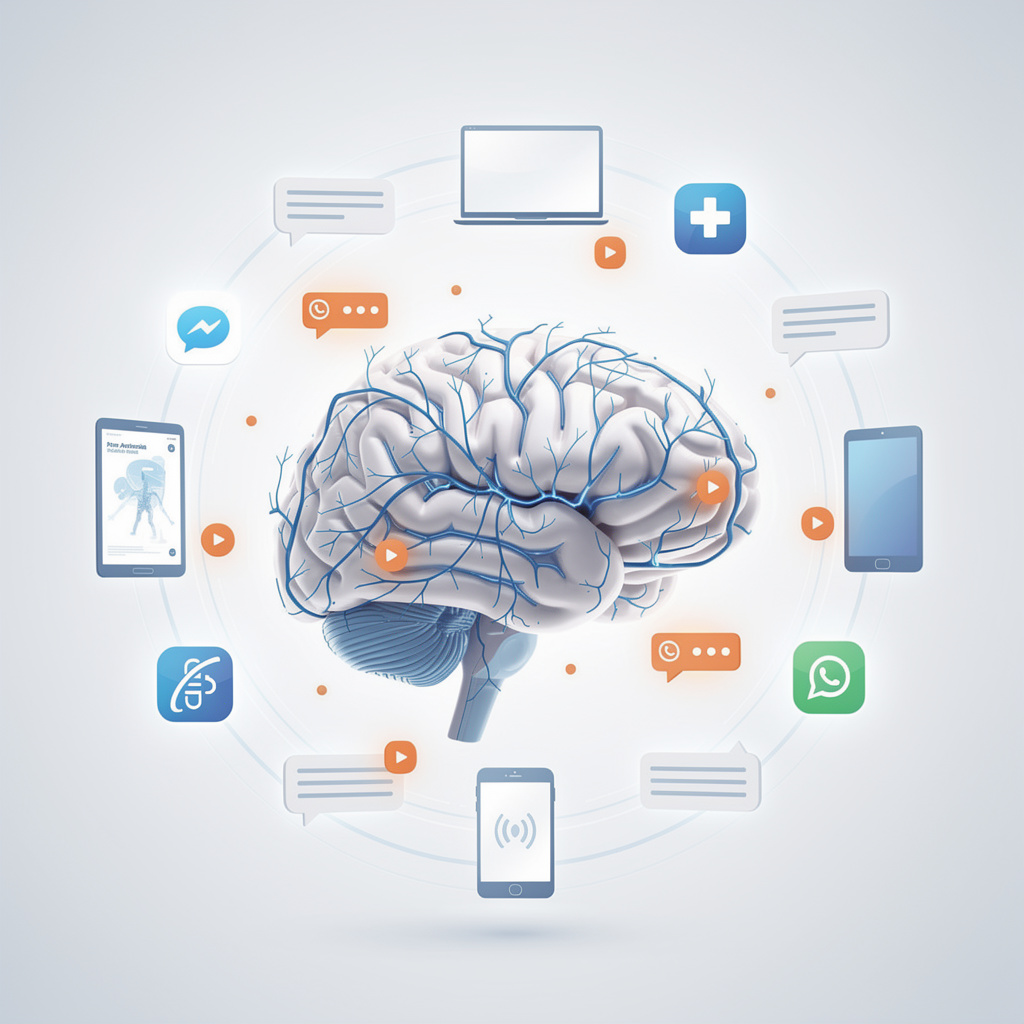
Digital overload affects your brain by triggering dopamine-driven feedback loops, depleting prefrontal cortex resources, creating attentional residue, and forcing the brain into continuous partial attention. The result is a brain that struggles to sustain focus on any single task and becomes increasingly dependent on external stimulation.
Dopamine reward loops. Every notification and unexpected update triggers dopamine release. Social media platforms exploit this through variable-ratio reinforcement schedules, the same unpredictable reward pattern that makes slot machines addictive. Research published in the British Journal of Psychiatry (2025) describes this as the “algorithmic dopamine economy,” where platforms compete to maximize engagement by fine-tuning reward timing.
Prefrontal cortex fatigue. The prefrontal cortex handles planning, decision-making, impulse control, and sustained attention. Every task switch taxes this region, and studies show heavy multitaskers experience measurable depletion, leading to poorer decision-making and reduced willpower.
Attentional residue. Researcher Sophie Leroy coined this term for what happens when you switch tasks: cognitive remnants of the previous task linger, impairing performance on the new one. Even a two-second glance at a notification creates residue that takes minutes to clear.
Dopamine is often described as the “pleasure chemical,” but it is more accurately a molecule of motivation and anticipation. It does not make you feel good when you receive a reward; it makes you want the reward. Social media exploits the wanting, not the having. The endless scroll works because your brain keeps anticipating that the next post will be the satisfying one. A 2026 study in Nature Translational Psychiatry confirmed that variable-reward digital interactions activate the same neural pathways implicated in behavioral addiction.
Yes, screen time significantly affects attention span. Research from UC Irvine’s Gloria Mark demonstrates that the average time a person spends on a single screen before switching has dropped from 2.5 minutes in 2004 to 75 seconds in 2012 to approximately 47 seconds today. The median is even lower: 40 seconds, meaning half of all screen-based attention episodes last 40 seconds or less.
Once your attention is broken, it takes an average of 25 minutes and 26 seconds to fully refocus, according to research cited by the American Psychological Association.
This decline reflects a fundamental shift in how our brains allocate attention. Pre-internet, sustained focused attention was the default mode. Today, divided attention has become the norm, and research from the APA consistently shows that heavy media multitaskers perform worse on tasks requiring sustained attention.
Digital overload takes a measurable toll on your physical and mental health through several interconnected pathways:
Chronic stress activation. Constant connectivity keeps your sympathetic nervous system in “fight or flight” mode. Your body responds to a deadline-driven email the same way it responds to a physical threat, with cortisol and adrenaline. A cross-sectional study in PMC/NIH found that IT professionals with prolonged screen time showed significantly elevated cortisol levels.
Sleep disruption. Blue light from screens suppresses melatonin production, fragmenting sleep cycles and reducing deep sleep quality essential for memory consolidation and cognitive recovery. Poor sleep further degrades attention the next day, creating a vicious cycle. See our article on how sleep enhances memory consolidation and learning.
Anxiety, eye strain, and physical symptoms. Social media feeds comparison-driven anxiety, while digital eye strain affects up to 90% of people who use screens for three or more hours daily, according to the American Optometric Association.
The connection between screen time and stress is not just psychological. It is physiological. A 2025 randomized controlled trial published in BMC Medicine found that reducing screen time to two hours per day for three weeks significantly improved depressive symptoms, perceived stress, sleep quality, and overall well-being. The stress your phone creates is real, measurable, and reversible.
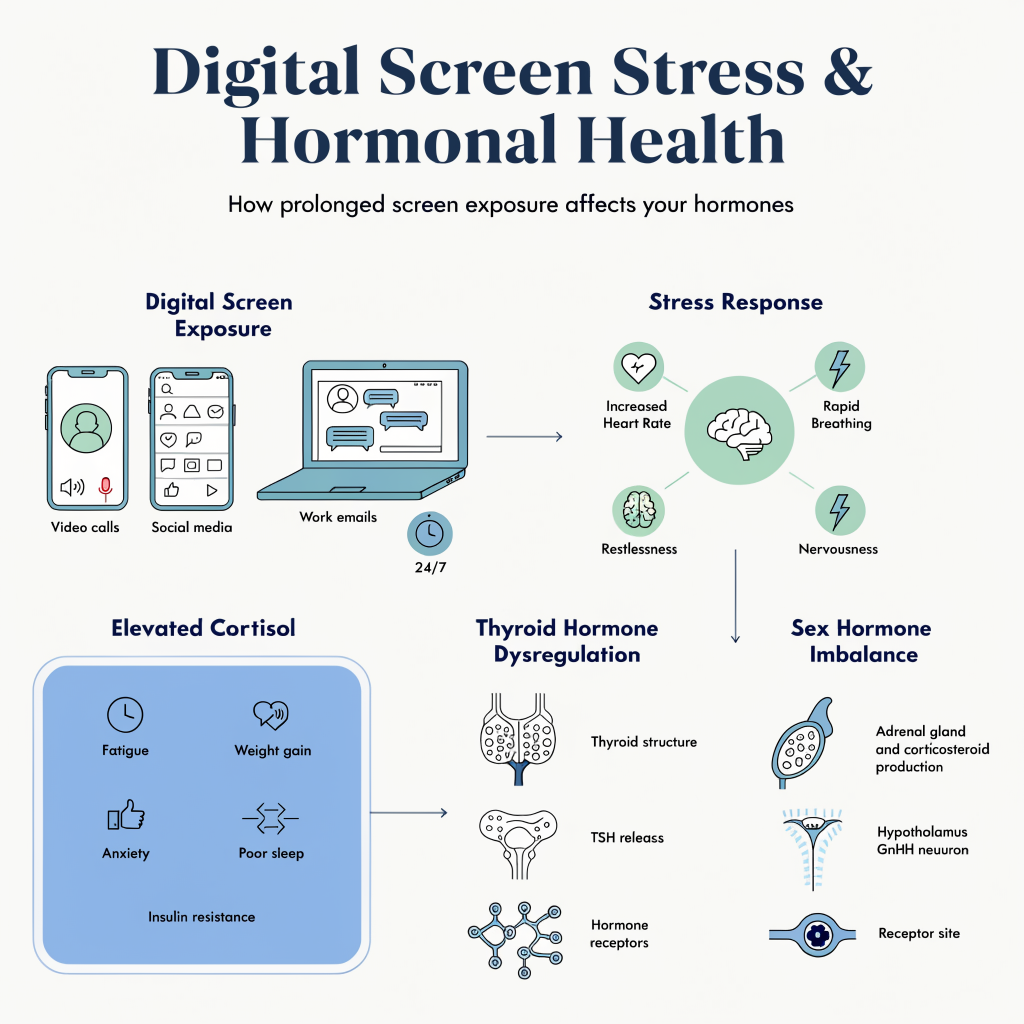
Chronic digital stress disrupts hormonal health by elevating cortisol, which in turn impairs thyroid function, sex hormone balance, and insulin sensitivity. This is the piece of the digital overload puzzle that most articles miss, and it may be the most impactful for long-term health.
Cortisol elevation. Chronic digital multitasking can spike cortisol levels by up to 60%, with elevated levels persisting for hours after screen exposure. When this happens daily, the HPA axis becomes dysregulated and loses its ability to return cortisol to baseline efficiently.
Thyroid disruption. Sustained HPA axis activation suppresses thyroid-stimulating hormone (TSH) production, impairs the conversion of T4 to active T3, and increases reverse T3. The result is a functional thyroid slowdown that can cause fatigue, brain fog, weight gain, and mood changes even when standard lab results appear “normal.” For a deeper look, see our article on how chronic stress disrupts thyroid health.
Sex hormone imbalance. When cortisol is chronically elevated, the body prioritizes cortisol production over sex hormones. This “cortisol steal” diverts pregnenolone away from progesterone and testosterone production. For women, this can mean irregular cycles and worsened PMS. For men, reduced testosterone and lower energy.
Insulin resistance and sleep-hormone disruption. Chronic cortisol elevation impairs insulin sensitivity, increasing metabolic risk. Blue light suppresses melatonin, disrupting the circadian rhythm that governs cortisol release, growth hormone, and reproductive hormone cycling.
If you are experiencing persistent fatigue, unexplained weight changes, or cognitive decline despite lifestyle changes, hormonal disruption from chronic digital stress may be a contributing factor. This is exactly what Infusion Health specializes in.
Digital overload builds gradually through subtle signs that are easy to dismiss:
If several of these resonate, it may be time to examine your digital habits. For deeper symptom coverage, see our articles on combating tech-induced cognitive fatigue and strategies to overcome brain fog.
You do not need to abandon technology entirely to reclaim your focus. Small, intentional changes produce measurable improvements:
For a more comprehensive breakdown, see our articles on digital detox strategies that actually work and unplugging for mental clarity and brain health.
Three recent studies support the benefits of reduced screen time. The PNAS Nexus RCT (2025) found that blocking mobile internet for two weeks improved sustained attention, mental health, and subjective well-being. The BMC Medicine RCT (2025) showed that reducing screen time to two hours daily for three weeks improved depressive symptoms, stress, and sleep quality. And a PLOS ONE study found that restricting digital media improved life satisfaction, mindfulness, and reduced stress in Gen Z participants. The pattern is consistent: less screen time, better mental and cognitive health.

Yes, you can reverse the effects of screen time on your attention span. The brain’s neuroplasticity means attention can be rebuilt at any age. The same mechanism that adapted your brain to constant digital stimulation works in reverse when you change the inputs.
Start small. Begin with five to ten minutes of single-tasking and gradually increase. The Pomodoro Technique, working in 25-minute focused blocks with 5-minute breaks, is an effective structure. As your focus improves, extend to 45/15 or 90/20 intervals.
Practice boredom tolerance. Deliberately allow your mind to wander without reaching for a device. Boredom activates the default mode network, which supports creativity, self-reflection, and memory consolidation. Reaching for your phone every time you feel bored robs your brain of this recovery process.
Move your body and spend time in nature. Aerobic exercise increases BDNF, a protein that supports neuroplasticity. Attention Restoration Theory demonstrates that even 20 minutes in a natural environment restores directed attention. See our article on how to reshape the brain for better cognitive outcomes.
Prioritize sleep and mindfulness. Consistent, high-quality sleep is non-negotiable for attention recovery. Regular meditation increases gray matter in brain regions associated with attention and executive function. Even ten minutes per day produces measurable changes within eight weeks. Our guide on harnessing mindfulness to rewire your brain for clarity offers practical guidance for getting started.
Digital overload is real, measurable, and scientifically documented. From declining attention spans to chronic hormonal disruption, the effects of our always-on digital lives run deeper than most people realize. Spending more than seven hours a day on screens actively reshapes your brain’s wiring and your body’s hormonal balance.
The good news: your brain has an extraordinary capacity to recover. Through neuroplasticity, small, consistent changes in your digital habits can produce meaningful improvements in focus, mood, sleep, and overall well-being within weeks. You do not need to quit technology entirely. You need to use it intentionally.
The hormonal health connection is the piece most people miss. Chronic digital stress elevates cortisol, which disrupts thyroid function, sex hormone balance, and insulin sensitivity. If you have been experiencing persistent fatigue, unexplained weight changes, or mood instability despite lifestyle adjustments, investigating hormonal disruption may be worthwhile.
At Infusion Health, we specialize in identifying the hormonal dimensions of health that standard checkups often miss. If you suspect digital overload may be affecting your hormonal balance, reach out to our team for a personalized assessment. For a broader look at brain-healthy lifestyle changes, see our article on how to boost brain health with proven lifestyle changes.
Your attention is one of your most valuable resources. Protect it deliberately, rebuild it intentionally, and give your brain the space it needs to thrive.