30+ Years
of Medical Experience

That afternoon bloat after a sandwich. The hives that appeared ten minutes after a plate of shrimp. Both are food reactions, yet they follow very different paths.
Understanding the food sensitivity vs food allergy distinction changes what your symptoms mean, how they get tested, and what to do next. This post draws the clinical line and maps where elimination and structured reintroduction fit.
A food allergy is an immune system response (Mayo Clinic). When someone with a true allergy eats a trigger food, their body makes a specific antibody called immunoglobulin E (IgE) against that food’s protein. On re-exposure, those antibodies signal mast cells and basophils to release histamine, and the reaction begins.
Most classic food allergies are IgE-mediated. Symptoms start within minutes and usually within two hours of eating (Cleveland Clinic). Mild signs include hives, itching, or a tingly mouth.
A systemic reaction involves more than one body system: widespread hives with vomiting, swelling of the lips or tongue, wheezing, dizziness, or a drop in blood pressure. The most severe form is anaphylaxis, where epinephrine is first-line treatment followed by emergency care. No sensitivity carries this risk spectrum.
Nine foods account for most allergic reactions in the United States: milk, eggs, peanuts, tree nuts, fish, shellfish, soy, wheat, and sesame. It is not rare: 6.7% of US adults report a diagnosed food allergy, and one large study put the clinical rate at 10.8%. One quirk matters: cross-reactivity, where proteins in one food resemble those in another (birch pollen and raw fruits), blurs what looks like a single trigger. With a confirmed allergy, avoid the food entirely, and never test that boundary alone.
Not every food allergy runs through IgE. Food protein-induced enterocolitis syndrome (FPIES) and eosinophilic esophagitis are allergy-type illnesses driven by other pathways, with delayed digestive or swallowing symptoms rather than hives. They are still allergies and still deserve specialist diagnosis rather than guesswork, one reason “allergy” gets used loosely.
A food sensitivity, sometimes called an intolerance, is a different kind of problem (see the AAFA allergist Q&A on allergy vs intolerance). Reactions arrive hours or even days after eating and are dose-dependent: a small serving may be fine, a large portion often is not. The discomfort is real, but sensitivities are not life-threatening the way IgE-mediated allergies are. They are believed to be more common than true food allergy, though the lack of a definitive test keeps prevalence hard to measure.
Instead of IgE, sensitivities may involve other parts of the immune response, such as immune complexes, or no immune mechanism at all, as with enzyme deficiencies. The pattern differs too: bloating, gas, cramping, headaches, fatigue, and skin changes on a delayed schedule. Because food sensitivities can affect your digestive system in many ways, linking a symptom to a food takes patience and structure rather than one test result.
Lactose intolerance is the classic example: without enough lactase enzyme, lactose ferments in the gut and produces gas and cramping. It is an enzyme problem, not an allergy, so a milk allergy and lactose intolerance need different responses. Other familiar patterns include FODMAP sensitivities (linked by the American College of Gastroenterology to IBS), non-celiac gluten sensitivity, and histamine intolerance tied to the DAO enzyme.
| Feature | Food Allergy | Food Sensitivity / Intolerance |
|---|---|---|
| Immune mechanism | IgE-mediated (or other allergy pathways) | Non-IgE (immune complexes) or non-immune |
| Onset | Minutes to 2 hours | Hours to days |
| Common symptoms | Hives, swelling, vomiting, anaphylaxis | Bloating, gas, cramping, headaches, fatigue |
| Severity | Potentially life-threatening | Uncomfortable, not life-threatening |
| How it is determined | Clinical history, skin-prick, specific-IgE blood test, oral food challenge | Clinical history, elimination trial, symptom tracking |
| Tolerance of small amounts | No, even trace amounts can trigger | Often yes, dose-dependent |
| Typical management | Strict avoidance, emergency epinephrine | Dietary adjustment, often limit rather than eliminate |
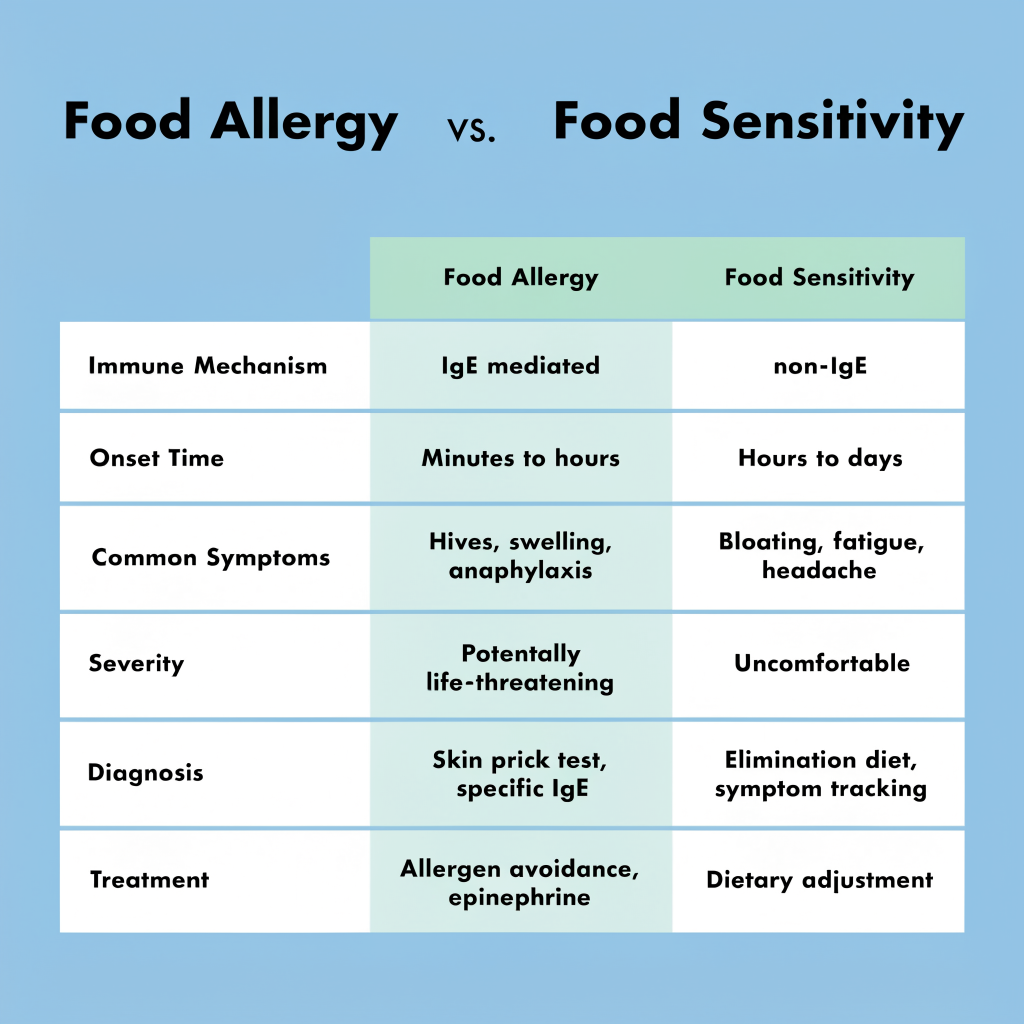
An allergy is a question of safety; a sensitivity is a question of tolerance, and mixing them up causes unnecessary fear or underestimated risk.
No single test settles both questions, as a 2024 clinical review of food allergies and sensitivities sets out.
Any good workup starts with a conversation: what you ate, how much, how long before symptoms started, and what those symptoms were. A few weeks of records linking meals to a reaction timeline often reveal patterns no blood test can, and that history guides which tests to order.
Skin-prick testing and specific-IgE blood tests are validated for one job: helping diagnose food allergy. They show whether your body has made IgE antibodies to a food. They cannot diagnose a sensitivity or intolerance, because those are not defined by IgE. False positives are common, so results only carry meaning when your allergist reads them alongside your history.
When testing and history point in different directions, the oral food challenge is the gold standard. Also called an oral provocation test, it happens in a medical setting: you eat gradually increasing amounts of the suspected food under observation. Research versions use a double-blind, placebo-controlled design, so neither you nor the clinician knows when the real food is served. This is definitive evidence for allergy and belongs entirely in clinical care, never in a home experiment.

You may have seen panels that measure IgG antibodies and hand back a long list of problem foods. IgG to a food generally reflects exposure, not intolerance: it rises for foods you eat often, the opposite of what an allergy test measures. Major allergy societies advise against IgG testing for diagnosis, and specialists say the same. Our post on food sensitivity test accuracy covers that evidence in depth.
When tests cannot answer the question, behavior can. An elimination diet works as a diagnostic trial: remove a suspected food for a defined period, watch whether symptoms change, then reintroduce it. It cannot separate allergy from sensitivity alone, which is why it belongs inside a guided process.
An elimination diet is a structured diagnostic tool, not a detox, not a weight-loss plan, and not a treatment. It answers one question: does removing this food change these symptoms? In practice that means a short, defined window of four to six weeks (per NIH clinical references), then reintroduction, with nutrition kept complete. If you and a clinician decide this fits, our elimination diet guide covers the how-to.
Open-ended restriction carries real risks. Cutting multiple food groups without planning can lead to nutrient deficiencies, unwanted weight loss, and eating patterns that are hard to unwind. These groups need professional support: children and adolescents, people who are pregnant or breastfeeding, anyone with an eating disorder history, people with complex medical conditions or multiple restrictions, and anyone with a suspected true food allergy.
Some situations move this work out of the self-guided column. If an IgE-mediated allergy is suspected, you have a history of severe reactions, or several foods are coming out at once, this belongs with an allergist, especially when symptoms are severe or nutrition is suffering. A short check-in before starting beats unwinding a restrictive pattern later, and a telemedicine consultation fits easily.
Elimination without reintroduction is just restriction. A fixed sequence separates a useful diagnostic trial from a vague experiment. The method below follows clinical protocols such as the Monash FODMAP reintroduction guide and the VA’s elimination diet guidance:
Before any food comes back, symptoms should be stable or resolved for at least three days. If you are still symptomatic during elimination, do not start yet: a flare already in motion gets blamed on whatever food you test next. Log your baseline: which symptoms remain, how strong, and when they appear.
Test single food groups in their simplest version, not as a mixed dish. To test dairy, use plain milk or plain yogurt, not lasagna: a reaction to a five-ingredient meal tells you nothing about which ingredient caused it. Isolating one variable per cycle is the point.
Give each food a three-day challenge phase. Day one: a small serving, roughly a quarter of a normal portion. Day two: half a portion, if day one produced nothing. Day three: a full serving, if the earlier days were quiet.
Then wait 72 hours before calling the result, since delayed reactions are what this method catches. Between cycles, return to baseline for two to three days.

A structured log turns impressions into data. For each entry record the date, time, amount, every symptom with a severity rating from one to ten, and when it started. Track digestive signs (bloat, gas, cramping, diarrhea, constipation) and wider ones (headache, fatigue, skin changes, brain fog). A plotted reaction timeline gives your clinician concrete detail instead of a vague impression.
If familiar symptoms return within the observation window after a food is reintroduced, that is a positive rechallenge: this food is probably a trigger for you right now. Take it back out of the plan and discuss the pattern with your clinician first. If symptoms are severe, meaning swelling, breathing difficulty, or repeated vomiting, stop: those can be signs of a true allergy. Seek emergency care and attempt no further challenges at home.
No symptoms across three days of escalating doses means your body tolerated that food this time. Keep it in your rotation and move to the next test food once you are back at baseline. Two caveats: tolerance can change over time, and one clean cycle does not rule out an allergy that needs medical confirmation.
This method is only for foods you have no reason to believe you are allergic to.
If you know or strongly suspect a food causes an IgE-mediated reaction, do not reintroduce it outside medical supervision. A true allergy can react to a trace amount, and anaphylaxis escalates quickly: swelling of the lips, tongue, or throat, difficulty breathing, wheezing, dizziness, rapid spreading hives, or vomiting soon after eating. If that happens, use prescribed epinephrine (an auto-injector such as an EpiPen) if you have one, call 911, and get to emergency care.

Reintroduction should be supervised rather than self-directed when any of these apply: a known or suspected true food allergy, a history of anaphylaxis, several foods challenged at once, unintended weight loss, an eating disorder history, or when children, pregnant individuals, or medically complex patients are involved. In those cases an allergist or dietitian runs the provocation steps where a reaction can be managed, and nothing here changes a prescribed treatment.
The goal is the least restrictive pattern of eating that supports how you feel, not an ever-growing list of banned foods. Sort what you learned into three buckets:
Tolerance is not fixed: sensitivities can shift with age, illness, and gut changes, so revisiting a limited food occasionally under clinical guidance is reasonable, while confirmed allergies are re-evaluated only with an allergist. Our gut health explainer and archive have more on the digestive side. Bring your symptom diary to a clinician and turn it into a long-term eating plan you want to keep.